
Predictive Modeling of NaOCl Dosage for Iron Removal in a Combined Aeration–Oxidation System Using Gene Expression Programming
Article Sidebar
Main Article Content
Abstract
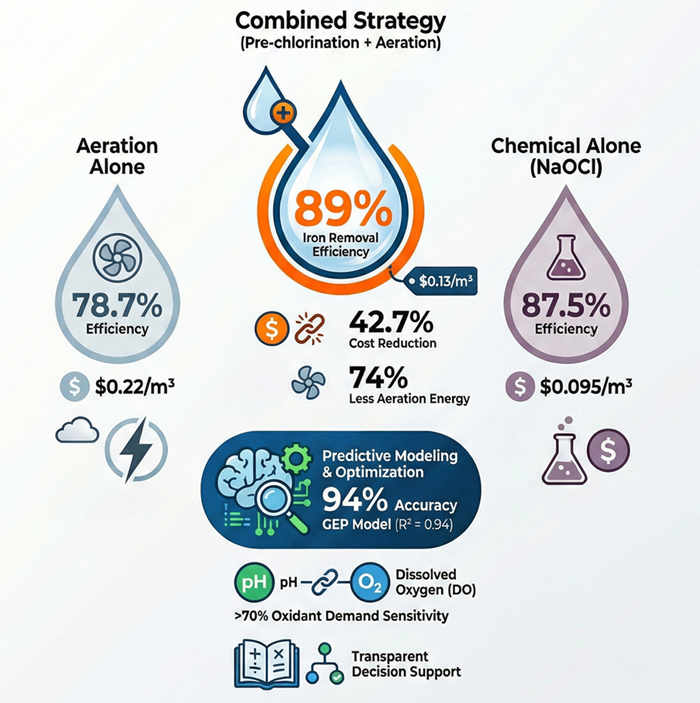
Iron is one of the most prevalent groundwater contaminants and can cause significant aesthetic, operational, and infrastructural problems when present at elevated concentrations. This study aims to (i) experimentally evaluate the effects of pH, dissolved oxygen (DO), and sodium hypochlorite (NaOCl) dosage on iron removal efficiency, and (ii) develop an interpretable Gene Expression Programming (GEP) model to predict the optimal NaOCl dose under varying water-quality conditions. Laboratory jar test experiments demonstrated that iron oxidation is strongly pH-dependent, with maximum removal efficiency (up to 99%) achieved under acidic conditions (pH 4) at a NaOCl dose of 6 mg/L due to hypochlorous acid predominance. Under practical near-neutral conditions relevant to drinking-water treatment (pH 6.5–7.5), aeration alone enhanced iron removal as DO increased, although diminishing returns were observed beyond 6 mg/L DO because of increased energy demand. A combined treatment strategy involving low-dose pre-chlorination followed by aeration exhibited a clear synergistic effect, achieving iron removal efficiencies of approximately 85–89% using NaOCl doses of 1–3 mg/L and DO levels of 4–5 mg/L. This approach reduced overall operational costs by approximately 40% compared with aeration-only treatment. The developed GEP model showed strong predictive performance (R² = 0.94; RMSE = 0.34 mg/L) and generated explicit mathematical expressions linking oxidant demand to pH, DO, and influent iron concentration. Overall, the study confirms the technical and economic advantages of pre-chlorination combined with aeration and highlights the potential of GEP as a transparent decision-support tool for optimizing groundwater iron removal.
Downloads
Article Details

This work is licensed under a Creative Commons Attribution-ShareAlike 4.0 International License.
Authors who publish with this journal agree to the following terms:
- Copyright of the published article belongs to the authors and grant the journal right of first publication with the work simultaneously licensed under a Creative Commons Attribution-ShareAlike 4.0 (CC BY SA) International License that allows others to share the work with an acknowledgment of the work's authorship and initial publication in this journal.
- Authors are able to enter into separate, additional contractual arrangements for the non-exclusive distribution of the journal's published version of the work (e.g., post it to an institutional repository or publish it in a book), with an acknowledgment of its initial publication in this journal.
- Authors are permitted and encouraged to post their work online (e.g., in institutional repositories or on their website) prior to and during the submission process, as it can lead to productive exchanges, as well as earlier and greater citation of published work (See the Effect of Open Access).
References
[1] T. L. Jolaosho, A. A. Mustapha, and S. T. Hundeyin, “Hydrogeochemical evolution and heavy metal characterization of groundwater from southwestern, Nigeria: An integrated assessment using spatial, indexical, irrigation, chemometric, and health risk models,” Heliyon, vol. 10, no. 19, 2024, https://doi.org/10.1016/j.heliyon.2024.e38364
[2] A. J. Natishah, M. S. Samuel, K. Velmurugan, S. R. Showparnickaa, S. M. Indumathi, and M. Kumar, “Contamination of groundwater by microorganisms and risk management: Conceptual model, existing data, and challenges,” Groundw. Sustain. Dev., vol. 29, p. 101408, 2025, https://doi.org/10.1016/j.gsd.2025.101408
[3] R. D. Alsaeed, B. Alaji, and L. Khouri, “Modeling chlorine residuals in urban water distribution networks (Al-Ashrafieh - Homs),” Environ. Res. Commun., vol. 6, no. 8, p. 81001, 2024, https://doi.org/10.1088/2515-7620/ad64b3
[4] World Health Organization (WHO), The World Health Report 2000 - Health Systems: Improving Performance. Geneva, Switzerland: World Health Organization, 2000.
[5] A. G. Tekerlekopoulou and D. V. Vayenas, “Simultaneous biological removal of ammonia, iron and manganese from potable water using a trickling filter,” Biochem. Eng. J., vol. 39, no. 1, pp. 215–220, 2008, https://doi.org/10.1016/j.bej.2007.09.005
[6] K. Teunissen, A. Abrahamse, H. Leijssen, L. Rietveld, and H. van Dijk, “Removal of both dissolved and particulate iron from groundwater,” Drink. Water Eng. Sci. Discuss., vol. 1, no. 1, pp. 87–115, 2008, https://doi.org/10.5194/dwesd-1-87-2008
[7] H. A. Aziz, H. A. Tajarudin, T. H. L. Wei, and M. Y. D. Alazaiza, “Iron and manganese removal from groundwater using limestone filter with iron-oxidized bacteria,” Int. J. Environ. Sci. Technol., vol. 17, no. 5, pp. 2667–2680, 2020, https://doi.org/10.1007/s13762-020-02681-5
[8] M. Deborde and U. von Gunten, “Reactions of chlorine with inorganic and organic compounds during water treatment-Kinetics and mechanisms: A critical review,” Water Res., vol. 42, no. 1–2, pp. 13–51, 2008, https://doi.org/10.1016/j.watres.2007.07.025
[9] Tech Brief, “Iron and Manganese Removal,” A national Drinking water Clearinghouse Sheet, 1998. https://actat.wvu.edu/files/d/a0d141dd-f559-412b-91df-bd1d14c52545/iron-mn-removal.pdf
[10] D. A. Lytle, D. Williams, C. Muhlen, E. Riddick, and M. Pham, “The removal of ammonia, arsenic, iron and manganese by biological treatment from a small Iowa drinking water system,” Environ. Sci. Water Res. Technol., vol. 6, no. 11, pp. 3142–3156, 2020, https://doi.org/10.1039/d0ew00361a
[11] C. Lytle and M. Edwards, “Mechanistic Study of Iron Sequestration by Phosphates,” ACS ES&T Water, vol. 5, no. 9, pp. 5309–5317, 2025, https://doi.org/10.1021/acsestwater.5c00411
[12] World Health Organization, A global overview of national regulations and standards for drinking-water quality. World Health Organization, 2021. [Online]. Available: https://www.who.int/publications/i/item/9789241513760
[13] F. Kozisek, “Regulations for calcium, magnesium or hardness in drinking water in the European Union member states,” Regul. Toxicol. Pharmacol., vol. 112, p. 104589, 2020, https://doi.org/10.1016/j.yrtph.2020.104589
[14] L. L. Pin, “Removal of Iron From Water Using Oxidation Process,” Universiti Tunku Abdul Rahman, 2021. [Online]. Available: http://eprints.utar.edu.my/5372/2/1603590_FYP.pdf
[15] G. Tredoux, S. Clarke, and L. C. Cavé, “The feasibility of in situ groundwater remediation as robust low-cost water treatment option,” Gezina, South Africa, 2004. [Online]. Available: https://www.wrc.org.za/wp-content/uploads/mdocs/1325-1-041.pdf
[16] M. Ghosh, “A study of the rate of oxidation of iron in aerated ground waters,” Dept. of Civil Engineering, University of Illinois, Urbana, 1962. [Online]. Available: https://www.ideals.illinois.edu/items/45718/bitstreams/135347/data.pdf
[17] J. F. Mcpeak and H. L. Aronovitch, “Iron in water and processes for its removal,” 21st Annu. Lib. Bell Corros. Course, 1983.
[18] J. Vercellotti, “Kinetics of Iron Removal Using Potassium Permanganate and,” Challenge. Ohio University, 1988.
[19] C. C. Kan, M. W. Wan, W. H. Chen, P. Phatai, J. Wittayakun, and K. F. Li, “The preliminary study of iron and manganese removal from groundwater by NaOCl oxidation and MF filtration,” Sustain. Environ. Res., vol. 22, no. 1, pp. 25–30, 2012. https://hero.epa.gov/reference/8222139/
[20] F. Mamadou, S. F. Mbacké, D. E. H. Moussa, T. A. Ousmane, M. F. Aminata, and D. M. C. Guèye, “Iron in Water: Study of Iron Removal Kinetics in Chemically Reconstituted Waters: Application to Groundwater of South Pout (PS2 Site),” Open J. Met., vol. 11, no. 01, pp. 1–10, 2021, https://doi.org/10.4236/ojmetal.2021.111001
[21] R. Buamah, B. Petrusevski, and J. C. Schippers, “Oxidation of adsorbed ferrous iron: Kinetics and influence of process conditions,” Water Sci. Technol., vol. 60, no. 9, pp. 2353–2363, 2009, https://doi.org/10.2166/wst.2009.597
[22] D. Vries et al., “Iron and manganese removal: Recent advances in modelling treatment efficiency by rapid sand filtration,” Water Res., vol. 109, pp. 35–45, 2017, https://doi.org/10.1016/j.watres.2016.11.032
[23] H. Kang, Y. Liu, D. Li, and L. Xu, “Study on the Removal of Iron and Manganese from Groundwater Using Modified Manganese Sand Based on Response Surface Methodology,” Appl. Sci., vol. 12, no. 22, p. 11798, 2022, https://doi.org/10.3390/app122211798
[24] D. Propolsky and V. Romanovski, “Iron and manganese removal from groundwater: comprehensive review of filter media performance and pathways to polyfunctional applications,” Environ. Sci. Water Res. Technol., 2025, https://doi.org/10.1039/d5ew00751h
[25] M. F. Naamah, “Smart Management of Fresh Water Uses in Syria Using a Neural Network Model,” Steps Civil, Constr. Environ. Eng., vol. 1, no. 2, pp. 40–50, 2023, https://doi.org/10.61706/sccee12011165
[26] R. Alsaeed, “Modelling turbidity removal by poly-aluminium chloride coagulant using gene expression,” Adv. Environ. Technol., vol. 7, no. 4, pp. 263–273, 2021, https://doi.org/10.22104/AET.2022.5303.1433
[27] G. Volf, M. Krbavčić, I. Sušanj Čule, and S. Zorko, “Prediction Models for Manganese, Iron and Ammonium in Raw Water for a Drinking Water Treatment Plant Butoniga (Croatia),” Eng. Rev., vol. 43, no. 3, pp. 68–80, 2023, https://doi.org/10.30765/er.2232
[28] R. D. Alsaeed, B. Alaji, and M. Ibrahim, “Modeling Jar Test Results Using Gene Expression to Determine the Optimal Alum Dose in Drinking Water Treatment Plants,” Baghdad Sci. J., vol. 19, no. 5, pp. 951–965, 2022, https://doi.org/10.21123/bsj.2022.6452
[29] S. McKelvey, A. Abassi, C. Nataraj, and M. Duran, “Data-driven modeling techniques for prediction of settled water turbidity in drinking water treatment,” Front. Environ. Eng., vol. 3, p. 1401180, 2024.
[30] A. M. Shrestha, S. Kazama, B. Sawangjang, and S. Takizawa, “Improvement of Removal Rates for Iron and Manganese in Groundwater Using Dual-Media Filters Filled with Manganese-Oxide-Coated Sand and Ceramic in Nepal,” Water (Switzerland), vol. 16, no. 17, p. 2450, 2024, https://doi.org/10.3390/w16172450
[31] H. Daraei et al., “DOC signal-based alum dose control for drinking water treatment plants,” J. Water Process Eng., vol. 54, p. 103934, 2023, https://doi.org/10.1016/j.jwpe.2023.103934
[32] H. Shin et al., “Development of water quality prediction model for water treatment plant using artificial intelligence algorithms,” Environ. Eng. Res., vol. 29, no. 2, 2024, https://doi.org/10.4491/eer.2023.198
[33] R. D. Alsaeed, B. Alaji, and M. Ibrahim, “Predicting aluminium using full-scale data of a conventional water treatment plant on Orontes River by ANN, GEP, and DT,” Int. J. Water, vol. 15, no. 3, pp. 190–206, 2023, https://doi.org/10.1504/IJW.2023.133991
[34] M. E. Sutharsan, S. P. S. Meegahakumbura, and N. S. Miguntanna, “Removal of Manganese and Iron from Groundwater by using Chlorination and Rapid Sand Filtration: A Case Study,” Eng. J. Inst. Eng. Sri Lanka, vol. 56, no. 2, pp. 13–21, 2023, https://doi.org/10.4038/engineer.v56i2.7529
[35] C. Ferreira, “Genetic Representation and Genetic Neutrality in Gene Expression Programming,” Adv. Complex Syst., vol. 05, no. 04, pp. 389–408, 2002, https://doi.org/10.1142/s0219525902000626
[36] C. Ferreira, “Function Finding and the Creation of Numerical Constants in Gene Expression Programming,” in Advances in Soft Computing, Springer, 2003, pp. 257–265. https://doi.org/10.1007/978-1-4471-3744-3_25
[37] C. Ferreira, “Gene Expression Programming in Problem Solving,” in Soft Computing and Industry, Springer, 2002, pp. 635–653. https://doi.org/10.1007/978-1-4471-0123-9_54
[38] N. Lewis-Rogers, K. A. Crandall, and D. Posada, Evolutionary analyses of genetic recombination. Kerala, India: Research Signpost, 2004. [Online]. Available: https://www.academia.edu/download/71599964/Evolutionary_analyses_of_genetic_recombi20211006-16515-6o5zej.pdf
[39] M. Achite et al., “Modern Techniques to Modeling Reference Evapotranspiration in a Semi-arid Area Based on ANN and GEP Models,” Water (Switzerland), vol. 14, no. 8, p. 1210, 2022, https://doi.org/10.3390/w14081210
[40] Hach Company, DR 2010 Spectrophotometer Instrument Manual. Loveland, USA: Hach Company, 1999. [Online]. Available: http://www.fieldenvironmental.com/assets/files/Manuals/HACH Spectrophotometer DR2010 Manual.pdf
[41] C. Ferreira, “Gene Expression Programming: a New Adaptive Algorithm for Solving Problems,” arXiv Prepr. cs/0102027, 2001, [Online]. Available: http://arxiv.org/abs/cs/0102027
[42] T. Thinojah and B. Ketheesan, “Iron removal from groundwater using granular activated carbon filters by oxidation coupled with the adsorption process,” J. Water Clim. Chang., vol. 13, no. 5, pp. 1985–1994, 2022, https://doi.org/10.2166/wcc.2022.126
[43] B. & V. Corporation, White’s Handbook of Chlorination and Alternative Disinfectants: Fifth Edition. John Wiley & Sons, 2010. https://doi.org/10.1002/9780470561331
[44] T. X. Wang and D. W. Margerum, “Kinetics of Reversible Chlorine Hydrolysis: Temperature Dependence and General-Acid/Base-Assisted Mechanisms,” Inorg. Chem., vol. 33, no. 6, pp. 1050–1055, 1994, https://doi.org/10.1021/ic00084a014
[45] D. Li, Y. Zhuang, Y. Hua, and B. Shi, “Effect of free chlorine on drinking water quality in old unlined cast iron pipes,” Chinese J. Environ. Eng., vol. 17, no. 2, pp. 675–681, 2023, https://doi.org/10.12030/j.cjee.202209001