
Engineering Design and Prototyping of an Automated Shuttlecock Feeder with Programmable Court-Zone Targeting
Article Sidebar
Main Article Content
Abstract
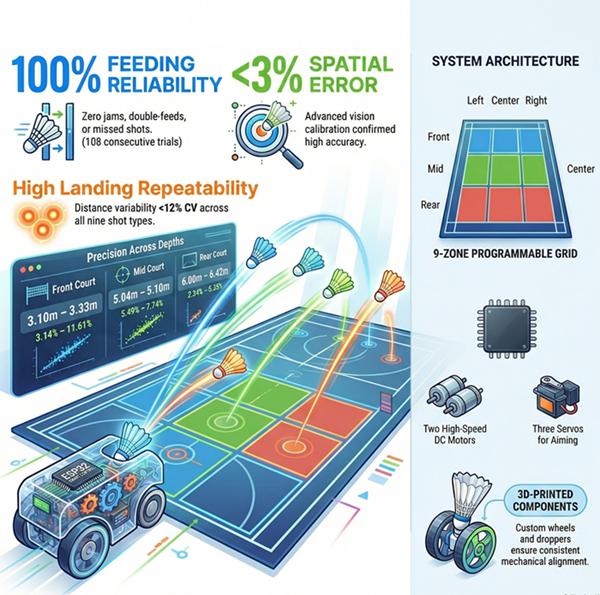
Manual multi-shuttle badminton drills can introduce variability in feeding rate and placement, reducing training standardization and complicating objective evaluation. Automated, programmable feeding with zone-based metrics can address this limitation. To design and validate a low-cost, automatic nine-shot shuttlecock feeder that delivers shuttlecocks to predefined court zones with controllable speed, direction, and timing. The prototype combined a wooden frame with 3D-printed dropper/ejector components and a dual-wheel launcher fixed at 30°. An ESP32 coordinated two DC motors (launch wheels) and three servomotors (dropper, ejector, and horizontal aiming). Nine-shot programs targeted a 3×3 court grid (left/center/right × front/mid/rear). The feeder was mounted 1.10 m above an indoor regulation court and 1.30 m from the net. For each zone, 12 feather shuttlecocks were launched (108 trials). Dual-camera video (60–120 fps) captured trajectory and top-view landings; Dartfish tagging and planar-homograph calibration converted pixel coordinates to court distances (mean spatial error <3%). All nine programs were executed successfully and produced distinct zone-specific landing distributions. Landing-distance variability was low (coefficient of variation <12% across programs), indicating strong repeatability under fixed settings; rear-court programs showed longer mean distances with similarly tight dispersion. Feeding reliability was 100% across 108 launches, with no blocking, double-feeding, or missed shots. Flight time and estimated near-field launch speed changed consistently with the programmed motor settings. The proposed feeder enables repeatable, structured multi-shuttle training and provides a practical framework for quantifying zone-delivery performance, with future work directed toward refining closed-loop targeting.
Downloads
Article Details

This work is licensed under a Creative Commons Attribution-ShareAlike 4.0 International License.
Authors who publish with this journal agree to the following terms:
- Copyright of the published article belongs to the authors and grant the journal right of first publication with the work simultaneously licensed under a Creative Commons Attribution-ShareAlike 4.0 (CC BY SA) International License that allows others to share the work with an acknowledgment of the work's authorship and initial publication in this journal.
- Authors are able to enter into separate, additional contractual arrangements for the non-exclusive distribution of the journal's published version of the work (e.g., post it to an institutional repository or publish it in a book), with an acknowledgment of its initial publication in this journal.
- Authors are permitted and encouraged to post their work online (e.g., in institutional repositories or on their website) prior to and during the submission process, as it can lead to productive exchanges, as well as earlier and greater citation of published work (See the Effect of Open Access).
References
[1] M. Phomsoupha and G. Laffaye, “The Science of Badminton: Game Characteristics, Anthropometry, Physiology, Visual Fitness and Biomechanics,” Sport. Med., vol. 45, no. 4, pp. 473–495, 2015, https://doi.org/10.1007/s40279-014-0287-2
[2] D. Cabello Manrique and J. J. González-Badillo, “Analysis of the characteristics of competitive badminton,” Br. J. Sports Med., vol. 37, no. 1, pp. 62–66, 2003, https://doi.org/10.1136/bjsm.37.1.62
[3] G. Laffaye, M. Phomsoupha, and F. Dor, “Changes in the game characteristics of a badminton match: A longitudinal study through the olympic game finals analysis in men’s singles,” J. Sport. Sci. Med., vol. 14, no. 3, pp. 584–590, 2015.
[4] F. Alvarez-Dacal et al., “Training vs. Competition: Load and Intensity Differences Between Multi-Feeding and Simulated Match Play in High-Level Youth Badminton Players,” Appl. Sci., vol. 15, no. 13, p. 7451, 2025, https://doi.org/10.3390/app15137451
[5] E. H. Wee, J. Y. Low, K. Q. Chan, and H. Y. Ler, “Effects of specific badminton training on aerobic and anaerobic capacity, leg strength qualities and agility among college players,” in Communications in Computer and Information Science, 2019, vol. 975, pp. 192–203. https://doi.org/10.1007/978-3-030-14526-2_13
[6] Y. Fu et al., “Comparison of Energy Contributions and Workloads in Male and Female Badminton Players During Games Versus Repetitive Practices,” Front. Physiol., vol. 12, p. 640199, 2021, https://doi.org/10.3389/fphys.2021.640199
[7] A. Edel, J. L. Weis, A. Ferrauti, and T. Wiewelhove, “Training drills in high performance badminton—effects of interval duration on internal and external loads,” Front. Physiol., vol. 14, p. 1189688, 2023, https://doi.org/10.3389/fphys.2023.1189688
[8] S. Sakai, R. Nobe, S. Mizuguchi, and S. Muraguchi, “Development of launcher machine with two rollers for badminton,” Trans. Japan Soc. Mech. Eng. Part C, vol. 77, no. 781, pp. 3415–3426, 2011, https://doi.org/10.1299/kikaic.77.3415
[9] M. H. Harun, S. F. A. Ghani, A. H. Azahar, M. S. M. Aras, M. I. Z. M. Zabidi, and A. S. Sadun, “An Improved Portable Shuttlecock Launcher for Training Purposes,” Int. J. Adv. Trends Comput. Sci. Eng., vol. 9, no. 5, pp. 8590–8598, 2020, https://doi.org/10.30534/ijatcse/2020/242952020
[10] J. Taryoto, “Shuttlecock launcher and method for launcher,” Jun. 22, 2003
[11] T. T. Tung, N. X. Quynh, and T. V. Minh, “A prototype of auto badminton training robot,” Results Eng., vol. 13, p. 100344, 2022, https://doi.org/10.1016/j.rineng.2022.100344
[12] M. Kopania, J. Nowisz, and A. Przelaskowski, “Automatic Shuttlecock Fall Detection System in or out of a Court in Badminton Games—Challenges, Problems, and Solutions from a Practical Point of View,” Sensors, vol. 22, no. 21, p. 8098, 2022, https://doi.org/10.3390/s22218098
[13] C. S. H. Lin, C. K. Chua, and J. H. Yeo, “Aerodynamics of badminton shuttlecock: Characterization of flow around a conical skirt with gaps, behind a hemispherical dome,” J. Wind Eng. Ind. Aerodyn., vol. 127, pp. 29–39, 2014, https://doi.org/10.1016/j.jweia.2014.02.002
[14] P. Punithan, R. Ramakrishnan, and G. Nallavan, “Design and Development of a Prototype Shuttlecock Feeder and Evaluation of Various Shot Parameters,” in Proceedings of the 5th International Conference on Inventive Research in Computing Applications, ICIRCA 2023, 2023, pp. 1672–1676. https://doi.org/10.1109/ICIRCA57980.2023.10220699
[15] L. M. Chen, Y. H. Pan, and Y. J. Chen, “A study of shuttlecock’s trajectory in badminton,” J. Sport. Sci. Med., vol. 8, no. 4, pp. 657–662, 2009.
[16] F. Alam, H. Chowdhury, C. Theppadungporn, H. Moria, and A. Subic, “A comparative study of feather and synthetic badminton shuttlecock aerodynamics,” 17th Australas. Fluid Mech. Conf. 2010, 2010, [Online]. Available: https://www.worldbadminton.com/reference/research/documents/174_Paper.pdf
[17] J. C. C. Tan, S. K. Foong, S. Veluri, and S. Sachdeva, “Testing of badminton shuttles with a prototype launcher,” in Impact of Technology on Sport II, CRC Press, 2008, pp. 443–448. https://doi.org/10.1201/9781439828427.ch64
[18] B. F. Yousif and K. S. Yeh, “Badminton training machine with impact mechanism,” J. Eng. Sci. Technol., vol. 6, no. 1, pp. 61–68, 2011.
[19] A. P. G. De Alwis, C. Dehikumbura, M. Konthawardana, T. D. Lalitharatne, and V. P. C. Dassanayake, “Design and Development of a Badminton Shuttlecock Feeding Machine to Reproduce Actual Badminton Shots,” in 2020 5th International Conference on Control and Robotics Engineering, ICCRE 2020, 2020, pp. 73–77. https://doi.org/10.1109/ICCRE49379.2020.9096444
[20] M. U. Aslam, A. Bashir, W. U. Draz, H. M. Mahmood Raja, and Kamran, “Optimized Shuttlecock Propulsion Machine to Facilitate Badminton Training,” in 1st International Conference on Electrical, Communication and Computer Engineering, ICECCE 2019, 2019, pp. 1–6. https://doi.org/10.1109/ICECCE47252.2019.8940685
[21] D. A. Kusuma et al., “Effect of light reaction agility training (LRAT) on agility performance of young male badminton players,” Retos, vol. 69, no. 69, pp. 110–117, 2025, https://doi.org/10.47197/retos.v69.113520
[22] F. H. Sholichin, S. Syahrorini, and A. Wisaksono, “Design An Automatic Shuttlecock Output Device Using An Arduino Based Servo Motor,” J. Comput. Networks, Archit. High Perform. Comput., vol. 5, no. 2, pp. 472–481, 2023, https://doi.org/10.47709/cnahpc.v5i2.2474
[23] J. Karamuz, P. Olejnik, and J. Awrejcewicz, “Programming and computer simulation of an experimental station for automatic launching of badminton shuttlecocks,” in Advances in Intelligent Systems and Computing, vol. 317, Springer, 2015, pp. 65–80. https://doi.org/10.1007/978-3-319-10990-9_7
[24] T. Saeeab and W. Phiphitphibunsuk, “A Unique 3D-Printed Shuttlecock Launcher With Three-Layer Sorting, Adjustable Positioning Barrier, and Dynamic Motor Holder,” ASME Lett. Transl. Robot., vol. 1, no. 1, p. 15001, 2025, https://doi.org/10.1115/1.4068344
[25] M. A. Kattimani, A. Raza, S. Ameer, and R. Scholar, “Design and Fabrication of Cricket Ball Launching Machine,” J. Ind. Eng. Its Appl., vol. 4, no. 3, pp. 19–31, 2019.
[26] I. Okoro and C. Enwerem, “Model-based Speed Control of a DC Motor Using a Combined Control Scheme,” in IEEE PES/IAS PowerAfrica Conference: Power Economics and Energy Innovation in Africa, PowerAfrica 2019, 2019, pp. 1–6. https://doi.org/10.1109/PowerAfrica.2019.8928856
[27] Y. A. Badamasi, “The working principle of an Arduino,” in Proceedings of the 11th International Conference on Electronics, Computer and Computation, ICECCO 2014, 2014, pp. 1–4. https://doi.org/10.1109/ICECCO.2014.6997578
[28] S. B. Hsiao and T. U. Ik, “Develop an AIoT Badminton Serving Machine,” in ACM International Conference Proceeding Series, 2023, pp. 15–21. https://doi.org/10.1145/3605731.3605882
[29] G. Nirmaladevi, S. P. Rajendran, M. Venugopalan, and K. Kalaivani, “Exploring the Impact of Shuttlecock Feeder-Based Training on Biomechanical Characteristics in Para-badminton Athletes,” Int. J. Disabil. Sport. Heal. Sci., vol. 8, no. 2, pp. 217–226, 2025, https://doi.org/10.33438/ijdshs.1582630
[30] Y. C. Huang, I. N. Liao, C. H. Chen, T. U. Ik, and W. C. Peng, “TrackNet: A deep learning network for tracking high-speed and tiny objects in sports applications,” in 2019 16th IEEE International Conference on Advanced Video and Signal Based Surveillance, AVSS 2019, 2019, pp. 1–8. https://doi.org/10.1109/AVSS.2019.8909871
[31] G. Waghmare, S. Borkar, V. Saley, H. Chinchore, and S. Wabale, “Badminton shuttlecock detection and prediction of trajectory using multiple 2 dimensional scanners,” in 2016 IEEE 1st International Conference on Control, Measurement and Instrumentation, CMI 2016, 2016, pp. 234–238. https://doi.org/10.1109/CMI.2016.7413746
[32] N. E. Sun et al., “TrackNetV2: Efficient Shuttlecock Tracking Network,” in Proceedings - 2020 International Conference on Pervasive Artificial Intelligence, ICPAI 2020, 2020, pp. 86–91. https://doi.org/10.1109/ICPAI51961.2020.00023
[33] J. Zhi, D. Luo, K. Li, Y. Liu, and H. Liu, “A novel method of shuttlecock trajectory tracking and prediction for a badminton robot,” Robotica, vol. 40, no. 6, pp. 1682–1694, 2022, https://doi.org/10.1017/S0263574721001053
[34] M. Lundberg et al., “Genetic, lifestyle and environmental risk factors for chronic pain revealed through GWAS,” bioRxiv, p. 2020.05.26.115568, 2020, https://doi.org/10.1101/2020.05.26.115568
[35] A. Cullinane, G. Davies, and P. O’Donoghue, An Introduction to Performance Analysis of Sport, Second Edition. Routledge, 2024. https://doi.org/10.4324/9781003375463
[36] C. Carling, T. Reilly, and A. M. Williams, Performance Assessment for Field Sports. Routledge, 2008. https://doi.org/10.4324/9780203890691
[37] J. Abian-Vicen, A. Castanedo, P. Abian, and J. Sampedro, “Temporal and notational comparison of badminton matches between men’s singles and women’s singles,” Int. J. Perform. Anal. Sport, vol. 13, no. 2, pp. 310–320, 2013, https://doi.org/10.1080/24748668.2013.11868650
[38] A. J. Cooke, “An overview of tennis ball aerodynamics,” Sport. Eng., vol. 3, no. 2, pp. 123–129, 2000, https://doi.org/10.1046/j.1460-2687.2000.00057.x
[39] R. Cross, “Impact of sports balls with striking implements,” Sport. Eng., vol. 17, no. 1, pp. 3–22, 2014, https://doi.org/10.1007/s12283-013-0132-0
[40] A. C. Cintra Faria and S. C. M. Barbalho, “Mechatronics: A Study on Its Scientific Constitution and Association with Innovative Products,” Appl. Syst. Innov., vol. 6, no. 4, p. 72, 2023, https://doi.org/10.3390/asi6040072
[41] M. Eltoukhy, S. Asfour, C. Thompson, and L. Latta, “Evaluation of the Performance of Digital Video Analysis of Human Motion: Dartfish Tracking System,” Int. J. Sci. Eng. Res., vol. 3, no. 3, pp. 1–6, 2012.
[42] S. Sakai and H. Shirayama, “Development of arm-type launching machine for badminton,” Trans. JSME (in Japanese), vol. 81, no. 822, pp. 14-00366-14–00366, 2015, https://doi.org/10.1299/transjsme.14-00366
[43] C. S. Lin, “Understanding and evaluation of badminton shuttlecocks through flight dynamics and experimental approach,” Nanyang Technological University, 2015.
[44] Y. K. Ooi, “Design and Fabrication of Shuttlecock Launcher (Mechanical Design),” Tunku Abdul Rahman University of Management and Technology, 2011.