
Spatial Analysis and Visualization of Edu-Tourism Clusters in MAMMINASATA, South Sulawesi: A GIS Approach to Attraction Identification and Classification
Article Sidebar
Main Article Content
Abstract
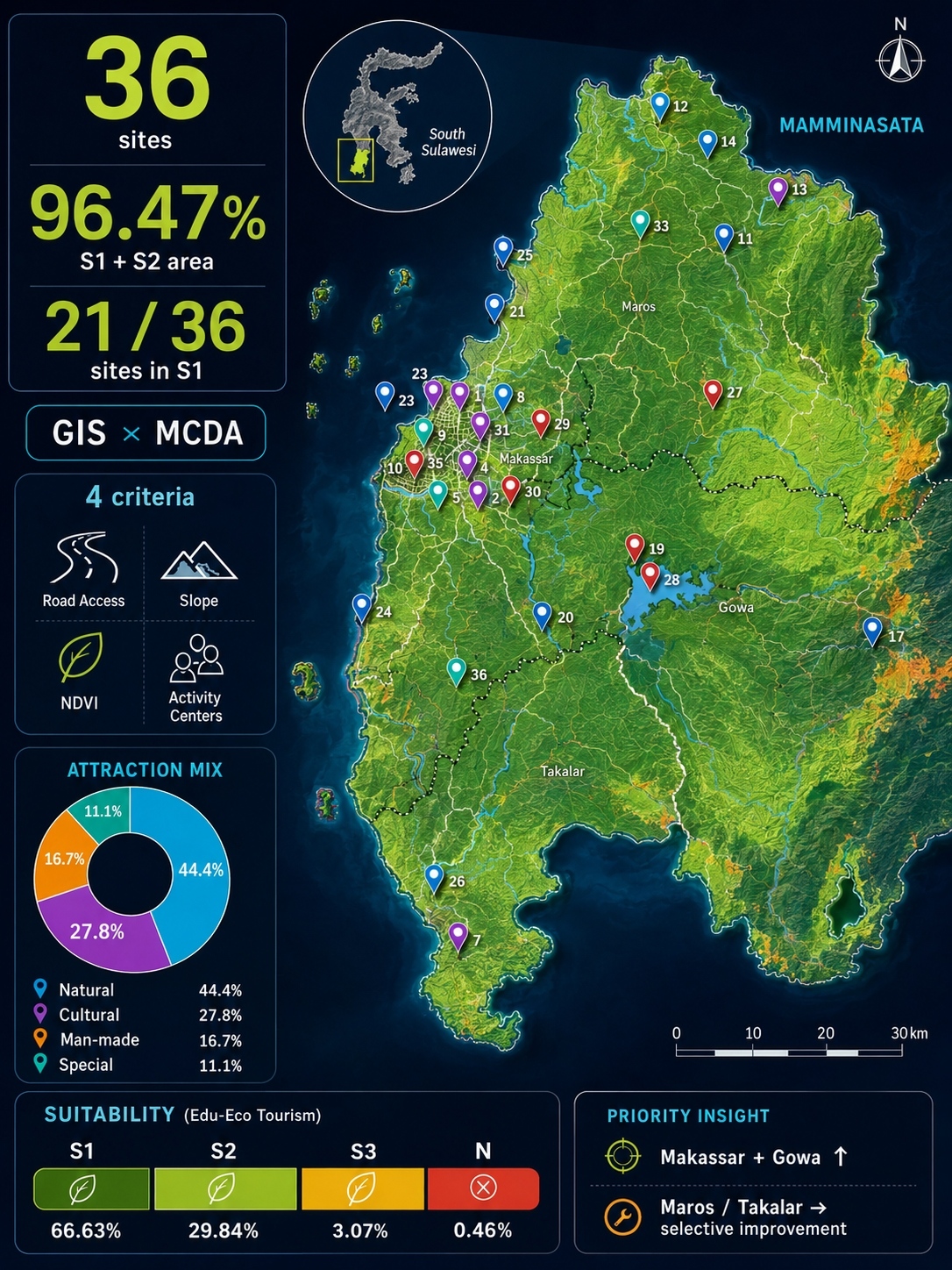
Educational tourism is increasingly understood as a spatially embedded learning resource system, yet its metropolitan-scale planning remains underexamined. This study analyzes the spatial distribution and land suitability of edu-tourism attractions in the MAMMINASATA Metropolitan Area, South Sulawesi, Indonesia, comprising Makassar, Gowa, Maros, and Takalar. Using a GIS-based weighted overlay approach, 36 georeferenced attractions were inventoried and classified into cultural, natural, man-made, and special-interest tourism. Spatial suitability was assessed through four criteria relevant to metropolitan planning: road accessibility, slope, vegetation density (NDVI), and proximity to activity centers. All datasets were standardized to a common suitability scale and integrated into a composite land-suitability model, after which suitability values were extracted at each attraction location. The results show that the edu-tourism resource base is dominated by natural attractions (44.40%) and cultural attractions (27.8%), with the strongest concentration in Makassar, Gowa, and Maros. The weighted overlay indicates that 66.63% of the study area is very suitable and 29.84% is suitable for edu-tourism development, meaning that 96.47% of the metropolitan area possesses supportive territorial conditions. At the site level, 58.3% of attractions are located in very suitable areas, 36.10% in suitable areas, and only 5.60% in moderately suitable areas, while no site falls into the not suitable class. These findings demonstrate that MAMMINASATA has strong potential for integrated edu-tourism planning, particularly in the Makassar-Gowa corridor, while more selective accessibility and service improvements are needed in parts of Maros and Takalar.
Downloads
Article Details

This work is licensed under a Creative Commons Attribution-ShareAlike 4.0 International License.
Authors who publish with this journal agree to the following terms:
- Copyright of the published article belongs to the authors and grant the journal right of first publication with the work simultaneously licensed under a Creative Commons Attribution-ShareAlike 4.0 (CC BY SA) International License that allows others to share the work with an acknowledgment of the work's authorship and initial publication in this journal.
- Authors are able to enter into separate, additional contractual arrangements for the non-exclusive distribution of the journal's published version of the work (e.g., post it to an institutional repository or publish it in a book), with an acknowledgment of its initial publication in this journal.
- Authors are permitted and encouraged to post their work online (e.g., in institutional repositories or on their website) prior to and during the submission process, as it can lead to productive exchanges, as well as earlier and greater citation of published work (See the Effect of Open Access).
References
[1] S. Tomasi, G. Paviotti, and A. Cavicchi, “Educational tourism and local development: The role of universities,” Sustain., vol. 12, no. 17, p. 6766, 2020, https://doi.org/10.3390/SU12176766
[2] B. W. Ritchie, Managing Educational Tourism, vol. 10. Channel View Publications, 2004.
[3] S. Zhang, J. Liu, and Y. Li, “Tourism Learning Resources and Development Strategies in China: A Review and Conceptual Framework,” Land, vol. 14, no. 7, p. 1421, 2025, https://doi.org/10.3390/land14071421
[4] Y. Chai, B. Dai, Y. Zhang, and Y. Wang, “Partnerships in educational tourism in China: a power perspective,” J. Sustain. Tour., vol. 33, no. 7, pp. 1330–1347, 2025, https://doi.org/10.1080/09669582.2024.2346789
[5] J. Bueddefeld and M. D. Duerden, “The transformative tourism learning model,” Ann. Tour. Res., vol. 94, p. 103405, 2022, https://doi.org/10.1016/j.annals.2022.103405
[6] C. A. McGladdery and B. A. Lubbe, “Rethinking educational tourism: proposing a new model and future directions,” Tour. Rev., vol. 72, no. 3, pp. 319–329, 2017, https://doi.org/10.1108/TR-03-2017-0055
[7] M. D. Kurniawan and H. Haryanto, “GOMS-based User Experience for Cultural Tourism Application in Indonesia,” Adv. Sustain. Sci. Eng. Technol., vol. 6, no. 1, 2024, https://doi.org/10.26877/asset.v6i1.17862
[8] J. H. Falk, R. Ballantyne, J. Packer, and P. Benckendorff, “Travel and Learning: A Neglected Tourism Research Area,” Ann. Tour. Res., vol. 39, no. 2, pp. 908–927, 2012, https://doi.org/10.1016/j.annals.2011.11.016
[9] C. M. van Winkle and K. Lagay, “Learning during tourism: the experience of learning from the tourist’s perspective,” Stud. Contin. Educ., vol. 34, no. 3, pp. 339–355, 2012, https://doi.org/10.1080/0158037X.2011.646981
[10] R. P. Sari and S. R. Henim, “Measurement and Analysis of Tourism Website User Experience Using Usability Techniques,” J. Appl. Eng. Technol. Sci., vol. 4, no. 1, pp. 539–546, 2022, https://doi.org/10.37385/jaets.v4i1.1343
[11] R. Ballantyne, J. Packer, and J. Falk, “Visitors’ learning for environmental sustainability: Testing short- and long-term impacts of wildlife tourism experiences using structural equation modelling,” Tour. Manag., vol. 32, no. 6, pp. 1243–1252, 2011, https://doi.org/10.1016/j.tourman.2010.11.003
[12] M. A. M. Mir, B. Shelley, and C. S. Ooi, “Uses of tourism resources for educational and community development: A systematic literature review and lessons,” Tour. Manag. Perspect., vol. 53, p. 101278, 2024, https://doi.org/10.1016/j.tmp.2024.101278
[13] L. Safriana, Nurhayati, Widiyani, and D. Suharjito, “Narrative-Driven Optimization for Sustainable Museum Networks: Integrating Freytag’s Pyramid and Hybrid PSO-Machine Learning Framework,” Adv. Sustain. Sci. Eng. Technol., vol. 7, no. 4, 2025, https://doi.org/10.26877/asset.v7i4.1954
[14] M. K. Sari, R. P. Lita, S. Lenggogeni, and M. Ma’ruf, “The Paradox of Smart Tourism: Does Technology Empower or Discourage Experience Sharing,” J. Appl. Eng. Technol. Sci., vol. 7, no. 1, pp. 519–538, 2025, https://doi.org/10.37385/jaets.v7i1.7353
[15] N. C. Withanage, D. Chanuwan Wijesinghe, P. K. Mishra, K. Abdelrahman, V. Mishra, and M. S. Fnais, “An ecotourism suitability index for a world heritage city using GIS-multi criteria decision analysis techniques,” Heliyon, vol. 10, no. 11, 2024, https://doi.org/10.1016/j.heliyon.2024.e31585
[16] D. Omarzadeh, S. Pourmoradian, B. Feizizadeh, H. Khallaghi, A. Sharifi, and K. V. Kamran, “A GIS-based multiple ecotourism sustainability assessment of West Azerbaijan province, Iran,” J. Environ. Plan. Manag., vol. 65, no. 3, pp. 490–513, 2022, https://doi.org/10.1080/09640568.2021.1887827
[17] E. Aksoy and B. T. San, “Geographical information systems (GIS) and Multi-Criteria Decision Analysis (MCDA) integration for sustainable landfill site selection considering dynamic data source,” Bull. Eng. Geol. Environ., vol. 78, no. 2, pp. 779–791, 2019, https://doi.org/10.1007/s10064-017-1135-z
[18] K. Bunruamkaew and Y. Murayama, “Site suitability evaluation for ecotourism using GIS & AHP: A case study of surat Thani Province, Thailand,” Procedia - Soc. Behav. Sci., vol. 21, pp. 269–278, 2011, https://doi.org/10.1016/j.sbspro.2011.07.024
[19] K. M. Ullah and R. Hafiz, “Finding suitable locations for ecotourism development in Cox’s Bazar using Geographical Information System and Analytical Hierarchy Process,” Geocarto Int., vol. 29, no. 3, pp. 256–267, 2014, https://doi.org/10.1080/10106049.2012.760005
[20] G. Hassanshahi, A. Soltani, M. Roosta, and S. Askari, “Walking as soft mobility: A multi-criteria GIS-based approach for prioritizing tourist routes,” Front. Archit. Res., vol. 12, no. 6, pp. 1080–1096, 2023, https://doi.org/10.1016/j.foar.2023.09.001
[21] C. Çetinkaya, M. Kabak, M. Erbaş, and E. Özceylan, “Evaluation of ecotourism sites: a GIS-based multi-criteria decision analysis,” Kybernetes, vol. 47, no. 8, pp. 1664–1686, 2018, https://doi.org/10.1108/K-10-2017-0392
[22] M. Salehipour, N. Kazemi, J. Jokar Arsanjani, and M. Karimi Firozjaei, “Developing a Multi-Criteria Decision Model to Unlock Sustainable Heritage Tourism Potential,” Sustain., vol. 17, no. 8, p. 3703, 2025, https://doi.org/10.3390/su17083703
[23] A. Acharya et al., “Geospatial Analysis of Geo-Ecotourism Site Suitability Using AHP and GIS for Sustainable and Resilient Tourism Planning in West Bengal, India,” Sustain., vol. 14, no. 4, p. 2422, 2022, https://doi.org/10.3390/su14042422
[24] Q. Quan and Y. Wu, “Integrating Entropy Weight and MaxEnt Models for Ecotourism Suitability Assessment in Northeast China Tiger and Leopard National Park,” Land, vol. 13, no. 8, p. 1269, 2024, https://doi.org/10.3390/land13081269
[25] F. Khazaee Fadafan, A. Soffianian, S. Pourmanafi, and M. Morgan, “Assessing ecotourism in a mountainous landscape using GIS – MCDA approaches,” Appl. Geogr., vol. 147, p. 102743, 2022, https://doi.org/10.1016/j.apgeog.2022.102743
[26] M. C. M. Parlato and A. Pezzuolo, “Rural–Urban Linkages and Development: A GIS-MCDA Approach to Sustainable Cyclo-Tourism and Rural Land Protection,” L. Degrad. Dev., vol. 36, no. 14, pp. 4809–4826, 2025, https://doi.org/10.1002/ldr.5669
[27] R. R. Putra, I. D. Perwitasari, D. M. Rangkuty, V. Tasril, S. Handayani, and A. S. Dewi, “From Virtual To Reality: How Metaverse and VR Technologies Influence Travel Decisions,” J. Appl. Eng. Technol. Sci., vol. 6, no. 2, pp. 862–873, 2025, https://doi.org/10.37385/jaets.v6i2.6314
[28] J. Malczewski, “GIS-based multicriteria decision analysis: A survey of the literature,” Int. J. Geogr. Inf. Sci., vol. 20, no. 7, pp. 703–726, 2006, https://doi.org/10.1080/13658810600661508
[29] C. Leake and J. Malczewski, GIS and Multicriteria Decision Analysis, vol. 51, no. 2. John wiley & sons, 2000. https://doi.org/10.2307/254268
[30] J. Malczewski, “GIS-based land-use suitability analysis: a critical overview,” Prog. Plann., vol. 62, no. 1, pp. 3–65, 2004.
[31] C. Antweiler, “Towards a cosmopolitan Indonesia: Makassar as a paradigm for organising cultural diversity?,” Asian J. Soc. Sci., vol. 47, no. 3, pp. 340–363, 2019, https://doi.org/10.1163/15685314-04703004
[32] A. M. Y. Hakim, S. Baja, D. A. Rampisela, S. Arif, M. Matsuoka, and I. Ridwansyah, “Assessment of future environmental carrying capacity in the Mamminasata area, Indonesia, derived from regional census and land cover,” Int. J. Environ. Stud., vol. 80, no. 5, pp. 1417–1434, 2023, https://doi.org/10.1080/00207233.2023.2204001
[33] F. Pucha-Cofrep and A. Fries, ArcGIS Pro Manual. Franz Pucha Cofrep, 2025.
[34] M. Drusch et al., “Sentinel-2: ESA’s optical high-resolution mission for GMES operational services,” Remote Sens. Environ., vol. 120, pp. 25–36, 2012, https://doi.org/10.1016/j.rse.2011.11.026
[35] C. J. Tucker, “Red and photographic infrared linear combinations for monitoring vegetation,” Remote Sens. Environ., vol. 8, no. 2, pp. 127–150, 1979, https://doi.org/10.1016/0034-4257(79)90013-0
[36] F. Joerin, M. Thérialult, and A. Musy, “Using GIS and outranking multicriteia analysis for land-use suitability assesment,” Int. J. Geogr. Inf. Sci., vol. 15, no. 2, pp. 153–174, 2001, https://doi.org/10.1080/13658810051030487
[37] J. Ommer et al., “The Impact of Spatial Resolutions on Nature-Based Solution Suitability Mapping for Europe,” Appl. Sci., vol. 14, no. 11, p. 4608, 2024, https://doi.org/10.3390/app14114608
[38] J. Malczewski, “Ordered weighted averaging with fuzzy quantifiers: GIS-based multicriteria evaluation for land-use suitability analysis,” Int. J. Appl. Earth Obs. Geoinf., vol. 8, no. 4, pp. 270–277, 2006, https://doi.org/10.1016/j.jag.2006.01.003
[39] A. Stein, W. Shi, and M. R. Delavar, “Preface-ISPRS international symposium on spatial data quality (ISSDQ 2019),” in International Archives of the Photogrammetry, Remote Sensing and Spatial Information Sciences - ISPRS Archives, 2019, vol. 42, no. 2/W13, pp. 1191–1192. https://doi.org/10.5194/isprs-archives-XLII-2-W13-1191-2019
[40] F. Zabel, B. Putzenlechner, and W. Mauser, “Correction: Global agricultural land resources - A high resolution suitability evaluation and its perspectives until 2100 under climate change conditions,” PLoS One, vol. 9, no. 12, p. e107522, 2014, https://doi.org/10.1371/journal.pone.0114980
[41] T. Orusa, A. Viani, D. Cammareri, and E. Borgogno Mondino, “A Google Earth Engine Algorithm to Map Phenological Metrics in Mountain Areas Worldwide with Landsat Collection and Sentinel-2,” Geomatics, vol. 3, no. 1, pp. 221–238, 2023, https://doi.org/10.3390/geomatics3010012
[42] L. Caiza-Morales, C. Gómez, R. Torres, A. P. Nicolau, and J. M. Olano, “MANGLEE: A Tool for Mapping and Monitoring MANgrove Ecosystem on Google Earth Engine—A Case Study in Ecuador,” J. Geovisualization Spat. Anal., vol. 8, no. 1, p. 17, 2024, https://doi.org/10.1007/s41651-024-00175-3
[43] N. Sahani, “Application of analytical hierarchy process and GIS for ecotourism potentiality mapping in Kullu District, Himachal Pradesh, India,” Environ. Dev. Sustain., vol. 22, no. 7, pp. 6187–6211, 2020, https://doi.org/10.1007/s10668-019-00470-w
[44] A. Iranmanesh and S. Abokhamis Mousavi, “Insights from the relationship between urban form, social media, and edu-tourism,” Curr. Issues Tour., vol. 26, no. 15, pp. 2559–2574, 2023, https://doi.org/10.1080/13683500.2022.2090908
[45] H. Alipour, H. Fatemi, and N. Malazizi, “Is edu-tourism a sustainable option? A case study of residents’ perceptions,” Sustainability, vol. 12, no. 15, p. 5937, 2020, https://doi.org/10.3390/su12155937
[46] J. Wang and J. Dolah, “A Framework for Facilitating Experiential Learning in Cultural Tourism,” Int. J. Virtual Pers. Learn. Environ., vol. 14, no. 1, pp. 1–24, 2024, https://doi.org/10.4018/IJVPLE.360381
[47] A. Durko and H. Martens, “Fostering higher level cultural learning among tourism students through virtual interaction,” J. Teach. Travel Tour., vol. 21, no. 3, pp. 235–247, 2021, https://doi.org/10.1080/15313220.2021.1880350
[48] M. Tong and T. Gao, “Beyond the classroom: Evaluating study tours’ impact on adolescents’ learning outcomes, psychological growth, and social responsibility,” Acta Psychol. (Amst)., vol. 261, p. 105740, 2025, https://doi.org/10.1016/j.actpsy.2025.105740
[49] S. X. Chen, L. Yu, S. W. T. Tse, and Y. Zhang, “When travel teaches: Unpacking student outcomes in educational tourism,” Tour. Manag. Perspect., vol. 58, p. 101385, 2025, https://doi.org/10.1016/j.tmp.2025.101385
[50] D. C. Moos and B. Honkomp, “Adventure learning: Motivating students in a Minnesota middle school,” J. Res. Technol. Educ., vol. 43, no. 3, pp. 231–252, 2011, https://doi.org/10.1080/15391523.2011.10782571
[51] M. W. Teoh, Y. Wang, and A. Kwek, “Deconstructing transformations: educational travellers’ cross-cultural transformative experiences,” J. Hosp. Tour. Manag., vol. 58, pp. 506–515, 2024, https://doi.org/10.1016/j.jhtm.2023.02.012
[52] W. H. Lee and G. Moscardo, “Understanding the impact of ecotourism resort experiences on tourists’ environmental attitudes and behavioural intentions,” J. Sustain. Tour., vol. 13, no. 6, pp. 546–565, 2005, https://doi.org/10.1080/09669580508668581
[53] K. Hughes, J. Packer, and R. Ballantyne, “Using post-visit action resources to support family conservation learning following a wildlife tourism experience,” Environ. Educ. Res., vol. 17, no. 3, pp. 307–328, 2011, https://doi.org/10.1080/13504622.2010.540644
[54] C. Tisdell and C. Wilson, “Perceived impacts of ecotourism on environmental learning and conservation: Turtle watching as a case study,” Environ. Dev. Sustain., vol. 7, no. 3, pp. 291–302, 2005, https://doi.org/10.1007/s10668-004-7619-6