
Exploring Energy Efficiency and User Attitudes toward Green Energy Implementation in University Buildings
Article Sidebar
Main Article Content
Abstract
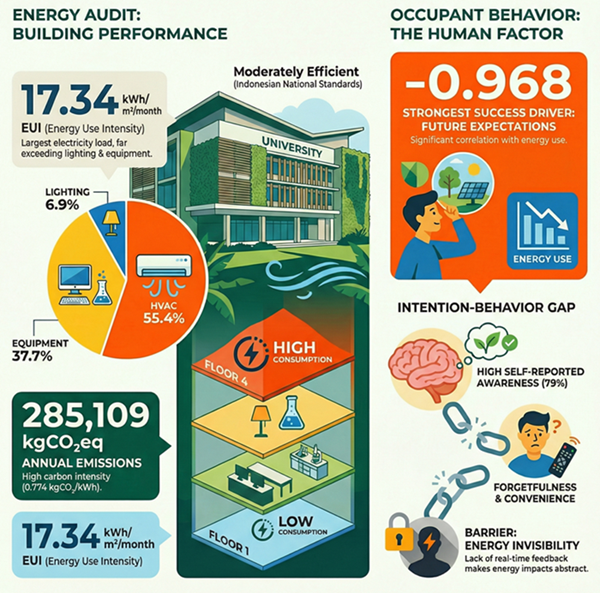
The global push for sustainable development has intensified the need to improve energy efficiency in higher education buildings, particularly in hot–humid tropical climates where cooling demand dominates electricity use. This study examines how occupant perceptions, environmental attitudes, and energy-related behaviors relate to measured building energy performance in a tropical university building, using a convergent parallel mixed-methods design. An ASHRAE Level 1–based energy audit (aligned with Indonesia’s MEMR Regulation No. 13/2012) profiled electricity consumption by end-use systems and was complemented by a 38-item questionnaire and semi-structured interviews with students, lecturers, and administrative staff. The audit estimated total annual electricity consumption of 366,897.7 kWh/year, corresponding to an average Energy Use Intensity (EUI) of 17.34 kWh/m²/month, and associated emissions of 285,108.85 kgCO₂eq. Cooling/HVAC accounted for the largest share of electricity use (≈55%), followed by plug loads/equipment and lighting. Survey results indicated generally high pro-environmental attitudes; however, quantitative associations between aggregated floor-level perceptions/behaviors and electricity use were exploratory, given the limited number of analytic units (four floors/zones). Still, floor-level correlations consistently suggested negative relationships between behavioral variables and energy consumption, with expectations toward green-energy practices showing a particularly strong inverse association (r = –0.968). Qualitative findings highlighted practical operational and behavioral drivers such as temperature setpoints, schedule discipline, and equipment shutdown practices, pointing to actionable opportunities for demand reduction. Overall, the study contributes an integrated audit–behavior perspective to support occupant-centered interventions, green-campus policy alignment, and sustainability-oriented learning activities for long-term low-carbon campus development in hot–humid contexts.
Downloads
Article Details

This work is licensed under a Creative Commons Attribution-ShareAlike 4.0 International License.
Authors who publish with this journal agree to the following terms:
- Copyright of the published article belongs to the authors and grant the journal right of first publication with the work simultaneously licensed under a Creative Commons Attribution-ShareAlike 4.0 (CC BY SA) International License that allows others to share the work with an acknowledgment of the work's authorship and initial publication in this journal.
- Authors are able to enter into separate, additional contractual arrangements for the non-exclusive distribution of the journal's published version of the work (e.g., post it to an institutional repository or publish it in a book), with an acknowledgment of its initial publication in this journal.
- Authors are permitted and encouraged to post their work online (e.g., in institutional repositories or on their website) prior to and during the submission process, as it can lead to productive exchanges, as well as earlier and greater citation of published work (See the Effect of Open Access).
References
[1] M. González-Torres, L. Pérez-Lombard, J. F. Coronel, I. R. Maestre, and D. Yan, “A review on buildings energy information: Trends, end-uses, fuels and drivers,” Energy Reports, vol. 8, pp. 626–637, 2022, https://doi.org/10.1016/j.egyr.2021.11.280
[2] J. Hossain et al., “A Review on Optimal Energy Management in Commercial Buildings,” Energies, vol. 16, no. 4, 2023, https://doi.org/10.3390/en16041609
[3] A. Kamal, S. Rahman, and N. Azmi, “Detailed profiling of high-rise building energy consumption in Southeast Asia,” J. Build. Eng., vol. 76, no. 107461, 2023, https://doi.org/10.1016/j.jobe.2023.107461
[4] Y. Su, “A Review on the Energy in Buildings: Current Research Focus,” Energy Build., vol. 298, no. 113520, 2024, https://doi.org/10.1016/j.enbuild.2024.113520
[5] H. Kalwry and C. Atakara, “Exploring Energy-Efficient Design Strategies in High-Rise Building Façades for Sustainable Development and Energy Consumption,” Buildings, vol. 15, no. 7, 2025, https://doi.org/10.3390/buildings15071062
[6] K. N. Paredes-Canencio, A. Lasso, R. Castrillon, J. R. Vidal-Medina, and E. C. Quispe, “Carbon footprint of higher education institutions,” Environ. Dev. Sustain., vol. 26, no. 12, pp. 30239–30272, 2024, https://doi.org/10.1007/s10668-024-04596-4
[7] A. Xu, Y. Zhu, and W. Li, “Study on Carbon Emissions of Typical Campus Buildings during the Use Stage,” J. Environ. Eng., vol. 151, no. 9, 2025, https://doi.org/10.1061/joeedu.eeeng-7867
[8] A. Van Sant, O. Ghatpande, R. Tuttle, and K. Trenbath, “Pathways to commercial building plug and process load efficiency and control,” Energy Effic., vol. 17, no. 8, pp. 1123–1135, 2024, https://doi.org/10.1007/s12053-024-10272-3
[9] M. Mikhail, “Lighting and Plug Load Energy Consumption: A COVID-19 Case Study,” in Proceedings of eSim 2024 (IBPSA-Canada), 2024, pp. 119–125.
[10] National Renewable Energy Laboratory, “NREL Researchers Reveal How Buildings Across the United States Do—and Could—Use Energy,” NREL, 2023. https://www.nlr.gov/news/detail/features/2023/nrel-researchers-reveal-how-buildings-across-the-united-states-do-and-could-use-energy?
[11] C. Ding, J. Ke, M. D. Levine, J. Granderson, and N. Zhou, “Potential of Artificial Intelligence in Reducing Energy and Carbon Emissions of Commercial Buildings at Scale,” Nat. Commun., vol. 15, no. 5916, 2024, https://doi.org/10.1038/s41467-024-50088-4
[12] C. C. Ejidike and M. C. Mewomo, “A Review of Barriers to the Adoption of Smart Building Concepts (SBCs) in Developing Countries,” in Lecture Notes in Civil Engineering, 2023, vol. 245, pp. 29–37. https://doi.org/10.1007/978-3-030-97748-1_3
[13] A. Aribi and K. Anouche, “Identifying challenges to smart buildings adoption in developing countries. The case of the Algerian context,” Energy Build., vol. 342, p. 115893, 2025, https://doi.org/10.1016/j.enbuild.2025.115893
[14] H. B. Gunay, W. O’Brien, and I. Beausoleil-Morrison, “Implementation and comparison of existing occupant behaviour models in EnergyPlus,” J. Build. Perform. Simul., vol. 9, no. 6, pp. 567–588, 2016, https://doi.org/10.1080/19401493.2015.1102969
[15] D. Yan et al., “Occupant behavior modeling for building performance simulation: Current state and future challenges,” Energy Build., vol. 107, pp. 264–278, 2015, https://doi.org/10.1016/j.enbuild.2015.08.032
[16] D. Kajjoba, R. Wesonga, J. D. Lwanyaga, H. Kasedde, P. W. Olupot, and J. B. Kirabira, “Assessment of thermal comfort and its potential for energy efficiency in low-income tropical buildings: a review,” Sustain. Energy Res., vol. 12, no. 1, p. 25, 2025, https://doi.org/10.1186/s40807-025-00169-9
[17] L. A. López-Pérez, J. J. Flores-Prieto, and C. Ríos-Rojas, “Adaptive thermal comfort model for educational buildings in a hot-humid climate,” Build. Environ., vol. 150, pp. 181–194, 2019, https://doi.org/10.1016/j.buildenv.2018.12.011
[18] IEA, “Space Cooling: Net Zero Emissions Guide,” IEA. IEA, Paris, 2023. [Online]. Available: https://www.iea.org/reports/space-cooling-2
[19] IPCC, “Climate information relevant for the Cities, Buildings, and Transport,” IPCC, 2021. https://www.ipcc.ch/report/ar6/wg1/downloads/factsheets/IPCC_AR6_WGI_Sectoral_Fact_Sheet_Cities_Buildings_Transport.pdf
[20] E. Delzendeh, S. Wu, A. Lee, and Y. Zhou, “The impact of occupants’ behaviours on building energy analysis: A research review,” Renew. Sustain. Energy Rev., vol. 80, pp. 1061–1071, 2017, https://doi.org/10.1016/j.rser.2017.05.264
[21] O. Ahmed, N. Sezer, M. Ouf, L. (Leon) Wang, and I. G. Hassan, “State-of-the-art review of occupant behavior modeling and implementation in building performance simulation,” Renew. Sustain. Energy Rev., vol. 185, p. 113558, 2023, https://doi.org/10.1016/j.rser.2023.113558
[22] B. Dong, D. Yan, P. Zangheri, J. Zhang, X. Zhou, and X. Zhou, “A global building occupant behavior database,” Sci. data, vol. 9, no. 1, p. 369, 2022, [Online]. Available: https://www.nature.com/articles/s41597-022-01475-3
[23] M. Alnahhal, O. Antar, A. Sakhrieh, and M. Al Hazza, “Analyzing Energy Consumption in Universities: A Literature Review,” Int. J. Energy Econ. Policy, vol. 14, no. 3, pp. 18–27, 2024, https://doi.org/10.32479/ijeep.15517
[24] S. Vyas and A. Sharma, “Energy Efficiency in Commercial Buildings: Challenges, Opportunities, and Solutions (Review),” J. Energy Conserv., vol. 1, no. 4, pp. 7–10, 2023, https://doi.org/10.14302/issn.2642-3146.jec-23-4568
[25] A. Zaballos, A. Briones, A. Massa, P. Centelles, and V. Caballero, “A smart campus’ digital twin for sustainable comfort monitoring,” Sustain., vol. 12, no. 21, pp. 1–33, 2020, https://doi.org/10.3390/su12219196
[26] J. Pan, R. Jain, S. Paul, T. Vu, A. Saifullah, and M. Sha, “An Internet of Things Framework for Smart Energy in Buildings: Designs, Prototype, and Experiments,” IEEE Internet Things J., vol. 2, no. 6, pp. 527–537, 2015, https://doi.org/10.1109/JIOT.2015.2413397
[27] M. S. Gul and S. Patidar, “Understanding the energy consumption and occupancy of a multi-purpose academic building,” Energy Build., vol. 87, pp. 155–165, 2015, https://doi.org/10.1016/j.enbuild.2014.11.027
[28] T. C. Quevedo, M. S. Geraldi, A. P. Melo, and R. Lamberts, “Benchmarking energy consumption in universities: A review,” J. Build. Eng., vol. 82, p. 108185, 2024, https://doi.org/10.1016/j.jobe.2023.108185
[29] M. Khoshbakht, Z. Gou, Y. Lu, X. Xie, and J. Zhang, “Are green buildings more satisfactory? A review of global evidence,” Habitat Int., vol. 74, pp. 57–65, 2018, https://doi.org/10.1016/j.habitatint.2018.02.005
[30] J. Litardo, M. Palme, R. Hidalgo-León, F. Amoroso, and G. Soriano, “Energy saving strategies and on-site power generation in a university building from a tropical climate,” Appl. Sci., vol. 11, no. 2, pp. 1–21, 2021, https://doi.org/10.3390/app11020542
[31] P. Sherman, H. Lin, and M. McElroy, “Projected global demand for air conditioning associated with extreme heat and implications for electricity grids in poorer countries,” Energy Build., vol. 268, p. 112198, 2022, https://doi.org/10.1016/j.enbuild.2022.112198
[32] Z. U. Rehman et al., “Do corporate social responsibility disclosures improve financial performance? A perspective of the Islamic banking industry in Pakistan,” Sustain., vol. 12, no. 8, p. 3302, 2020, https://doi.org/10.3390/SU12083302
[33] G. Kanagaraj and A. Mahalingam, “Designing energy efficient commercial buildings - A systems framework,” Energy Build., vol. 43, no. 9, pp. 2329–2343, 2011, https://doi.org/10.1016/j.enbuild.2011.05.023
[34] Y. H. Yau, U. A. Rajput, and A. Badarudin, “A comprehensive review of variable refrigerant flow (VRF) and ventilation designs for thermal comfort in commercial buildings,” J. Therm. Anal. Calorim., vol. 149, no. 5, pp. 1935–1961, 2024, https://doi.org/10.1007/s10973-023-12837-3
[35] L. Schibuola, M. Scarpa, and C. Tambani, “Performance optimization of a demand controlled ventilation system by long term monitoring,” Energy Build., vol. 169, pp. 48–57, 2018, https://doi.org/10.1016/j.enbuild.2018.03.059
[36] I. Ajzen, “The theory of planned behavior,” Handbook of Theories of Social Psychology: Volume 1. pp. 438–459, 2012. https://doi.org/10.4135/9781446249215.n22
[37] P. C. Stern, “Toward a coherent theory of environmentally significant behavior,” J. Soc. Issues, vol. 56, no. 3, pp. 407–424, 2000, https://doi.org/10.1111/0022-4537.00175
[38] J. W. Creswell and V. L. Plana Clark, Designing and conducting mixed methods research. SAGE Publications, Inc, 2011.
[39] Ministry of Energy and Mineral Resources (ESDM) of the Republic of Indonesia, Regulation of the Minister of Energy and Mineral Resources of the Republic of Indonesia Number 13 of 2012 on Electricity Consumption Efficiency (Energy Saving Measures). Indonesia, Indonesia, 2012. [Online]. Available: https://jdih.esdm.go.id/dokumen/view?id=760
[40] American Society of Heating Refrigerating and Air-Conditioning Engineers (ASHRAE), 2013 ASHRAE Handbook: Fundamentals. Atlanta: ASHRAE, 2013.
[41] J. Litardo, R. Hidalgo-Leon, and G. Soriano, “Energy performance and benchmarking for university classrooms in hot and humid climates,” Energies, vol. 14, no. 21, p. 7013, 2021, https://doi.org/10.3390/en14217013
[42] M. L. Da Silva Costa, M. R. Freire, K. F. Da Silva, and F. G. M. Freires, “Analysis of Energy Consumption Related To the Use of Air Conditioning in University Buildings in a Tropical Climate,” Rev. Gest. Soc. e Ambient., vol. 16, no. 2, p. e03025, 2022, https://doi.org/10.24857/rgsa.v16n2-019
[43] M. A. A. Abdullah, M. A. Razali, I. F. Ismail, W. Sani, and J. Taweekun, “Energy Profile and Building Energy Index (BEI) for Malaysian Public University: A Case Study of Universiti Tun Hussein Onn Malaysia (UTHM),” Int. J. Integr. Eng., vol. 17, no. 1, pp. 107–116, 2025, https://doi.org/10.30880/ijie.2025.17.01.009
[44] S. D’Oca, T. Hong, and J. Langevin, “The human dimensions of energy use in buildings: A review,” Renew. Sustain. Energy Rev., vol. 81, pp. 731–742, 2018, https://doi.org/10.1016/j.rser.2017.08.019
[45] N. Liu, X. Luo, X. Liu, and M. Xing, “Impacts of normative information on college students’ energy-saving intentions and behaviors in the dormitory,” Energy Built Environ., vol. 6, no. 2, pp. 347–361, 2025, https://doi.org/10.1016/j.enbenv.2023.12.001
[46] I. Chaer, B. Ozarisoy, M. A. Elnour Ismail, S. Salari, and Y. Zhihui, “Energy efficiency in educational buildings: A systematic review of smart technology integration and occupant behaviour,” Build. Environ., vol. 280, 2025, https://doi.org/10.1016/j.buildenv.2025.113132
[47] A. Ghofrani, E. Zaidan, and A. Abulibdeh, “Simulation and impact analysis of behavioral and socioeconomic dimensions of energy consumption,” Energy, vol. 240, p. 122502, 2022, https://doi.org/10.1016/j.energy.2021.122502
[48] S. Garimella, K. Lockyear, D. Pharis, O. El Chawa, M. T. Hughes, and G. Kini, “Realistic pathways to decarbonization of building energy systems,” Joule, vol. 6, no. 5, pp. 956–971, 2022, https://doi.org/10.1016/j.joule.2022.04.003
[49] N. Z. Khanna, J. Zhang, H. Lu, W. Feng, M. Johnson-Wang, and N. Zhou, “Conceptualizing demand-side technological and social innovations in modeling pathways to carbon neutrality,” Energy Res. Soc. Sci., vol. 100, p. 103115, 2023, https://doi.org/10.1016/j.erss.2023.103115
[50] International Energy Agency, “Energy Efficiency 2024: Accelerating climate-smart transitions in buildings,” 2024.
[51] P. Faria, “Energy consumption in higher-education institutions: A bibliometric analysis of scientific trends,” Buildings, vol. 12, no. 3, p. 323, 2022, https://doi.org/10.3390/buildings12020108
[52] F. Xu, G. Gao, and L. Ni, “A New Adaptive Federated Cubature Kalman Filter Based on Chi-Square Test for SINS/GNSS/SRS/CNS Integration,” Math. Probl. Eng., vol. 2022, 2022, https://doi.org/10.1155/2022/7588265
[53] H. B. Truelove, A. R. Carrico, E. U. Weber, K. T. Raimi, and M. P. Vandenbergh, “Positive and negative spillover of pro-environmental behavior: An integrative review and theoretical framework,” Glob. Environ. Chang., vol. 29, pp. 127–138, 2014, https://doi.org/10.1016/j.gloenvcha.2014.09.004
[54] I. C. Konstantakopoulos, A. R. Barkan, S. He, T. Veeravalli, H. Liu, and C. Spanos, “A deep learning and gamification approach to improving human-building interaction and energy efficiency in smart infrastructure,” Appl. Energy, vol. 237, pp. 810–821, 2019, https://doi.org/10.1016/j.apenergy.2018.12.065
[55] United Nations Environment Programme, “Buildings and climate global status report 2023,” UNEP, 2023. https://www.unep.org/resources/report/global-status-report-buildings-and-construction
[56] G. Ma, J. Lin, N. Li, and J. Zhou, “Cross-cultural assessment of the effectiveness of eco-feedback in building energy conservation,” Energy Build., vol. 134, pp. 329–338, 2017, https://doi.org/10.1016/j.enbuild.2016.11.008
[57] G. N. Dixon, M. B. Deline, K. McComas, L. Chambliss, and M. Hoffmann, “Using Comparative Feedback to Influence Workplace Energy Conservation: A Case Study of a University Campaign,” Environ. Behav., vol. 47, no. 6, pp. 667–693, 2015, https://doi.org/10.1177/0013916513520417