
Design, Environmental Validation, and Candidate Crop Screening in a Modular Micro-Lunar Greenhouse System under CELSS-Like Conditions
Article Sidebar
Main Article Content
Abstract
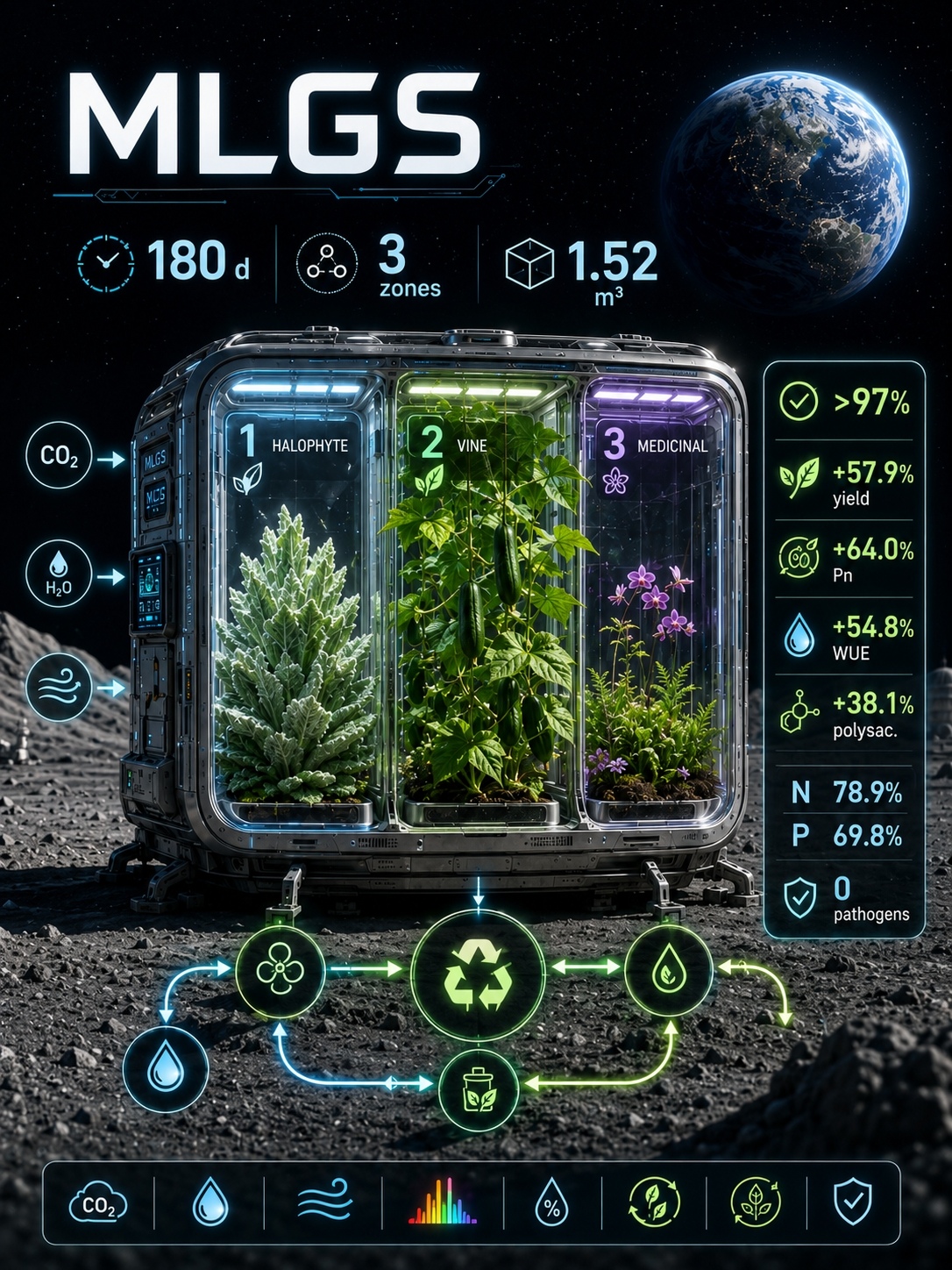
Controlled Ecological Life Support Systems (CELSS) require reliable in situ crop production for long-duration lunar and planetary habitation. However, existing research infrastructure remains divided between large, expensive facilities and conventional growth chambers that lack the environmental realism needed for standardized crop screening. This study aimed to design, engineer, and experimentally validate a Micro-Lunar Greenhouse System (MLGS) as a mid-scale modular platform for evaluating functionally diverse candidate crops under CELSS-like conditions. The 1.52 m3 MLGS integrated automated control of atmospheric composition, temperature, relative humidity, airflow, hydroponics, and programmable LED lighting across three independent cultivation zones. Mesembryanthemum crystallinum, Anredera cordifolia, and Anoectochilus roxburghii were cultivated for 180 days under species-optimized MLGS conditions and compared with standard laboratory chamber conditions using three biological replicates per treatment. Platform performance and crop responses were assessed through environmental stability, growth, photosynthetic traits, nutritional and bioactive composition, resource-use efficiency, waste-processing capacity, and microbial safety. The MLGS maintained environmental setpoints within ±0.8°C, ±1.5% relative humidity, and 25-35 ppm CO2 of target values for more than 97% of operating time, with low spatial heterogeneity among cultivation zones. Relative to the control, the optimized MLGS treatment increased biomass by 38-62%, enhanced key nutritional or bioactive compounds by 24-46%, and improved water-use efficiency by 25-55%. Nitrogen and phosphorus removal from simulated waste streams reached 58-79% and 47-70%, respectively, and no foodborne pathogens were detected. These results validate the MLGS as a reproducible bridge platform between large CELSS facilities and conventional growth chambers, supporting standardized crop screening for future space agriculture applications.
Downloads
Article Details

This work is licensed under a Creative Commons Attribution-ShareAlike 4.0 International License.
Authors who publish with this journal agree to the following terms:
- Copyright of the published article belongs to the authors and grant the journal right of first publication with the work simultaneously licensed under a Creative Commons Attribution-ShareAlike 4.0 (CC BY SA) International License that allows others to share the work with an acknowledgment of the work's authorship and initial publication in this journal.
- Authors are able to enter into separate, additional contractual arrangements for the non-exclusive distribution of the journal's published version of the work (e.g., post it to an institutional repository or publish it in a book), with an acknowledgment of its initial publication in this journal.
- Authors are permitted and encouraged to post their work online (e.g., in institutional repositories or on their website) prior to and during the submission process, as it can lead to productive exchanges, as well as earlier and greater citation of published work (See the Effect of Open Access).
References
[1] V. Maiwald, K. Kyunghwan, V. Vrakking, and C. Zeidler, “From Antarctic prototype to ground test demonstrator for a lunar greenhouse,” Acta Astronaut., vol. 212, pp. 246–260, 2023, https://doi.org/10.1016/j.actaastro.2023.08.012
[2] J. W. Prats, D. K. S. Souffront, M. S. B. Bhaskar, and K. Jayachandran, “Development of a Controlled-environment Plant Growth Chamber Using a Shipping Container for Industrial Hemp (Cannabis sativa L.) Cultivation,” Horttechnology, vol. 36, no. 1, pp. 24–30, 2026, https://doi.org/10.21273/HORTTECH05767-25
[3] J. Guerrero-Sánchez et al., “Design and Implementation of a Low-Cost Controlled-Environment Growth Chamber for Vegetative Propagation of Mother Plants,” AgriEngineering, vol. 7, no. 6, p. 177, 2025, https://doi.org/10.3390/agriengineering7060177
[4] F. Ben Othman, S. Delattaignant, A. L. Alexandre, M. Roque, and C. Roque, “Development and evaluation of a climatic chamber with the potential to enhance plant resilience and optimize agricultural productivity,” Therm. Sci. Eng. Prog., vol. 62, p. 103645, 2025, https://doi.org/10.1016/j.tsep.2025.103645
[5] G. Metelli et al., “Design of a modular controlled unit for the study of bioprocesses: Towards solutions for Bioregenerative Life Support Systems in space,” Life Sci. Sp. Res., vol. 36, pp. 8–17, 2023, https://doi.org/10.1016/j.lssr.2022.10.006
[6] V. De Micco et al., “Plant and microbial science and technology as cornerstones to Bioregenerative Life Support Systems in space,” npj Microgravity, vol. 9, no. 1, p. 69, 2023, https://doi.org/10.1038/s41526-023-00317-9
[7] D. Marshall Porterfield et al., “Critical investments in bioregenerative life support systems for bioastronautics and sustainable lunar exploration,” npj Microgravity, vol. 11, no. 1, p. 57, 2025, https://doi.org/10.1038/s41526-025-00518-4
[8] H. C. Wright et al., “Space controlled environment agriculture offers pathways to improve the sustainability of controlled environmental agriculture on Earth,” Nat. Food, vol. 4, no. 8, pp. 648–653, 2023, https://doi.org/10.1038/s43016-023-00819-5
[9] R. Fritsche et al., “Space Crop Considerations for Human Exploration,” National Aeronautics and Space Administration, 2024. [Online]. Available: https://ntrs.nasa.gov/citations/20250001897
[10] L. Poulet et al., “Large-Scale Crop Production for the Moon and Mars: Current Gaps and Future Perspectives,” Front. Astron. Sp. Sci., vol. 8, p. 733944, 2022, https://doi.org/10.3389/fspas.2021.733944
[11] S. Chen, A. Liu, F. Tang, P. Hou, Y. Lu, and P. Yuan, “A Review of Environmental Control Strategies and Models for Modern Agricultural Greenhouses,” Sensors, vol. 25, no. 5, p. 1388, 2025, https://doi.org/10.3390/s25051388
[12] E. Iddio, L. Wang, Y. Thomas, G. McMorrow, and A. Denzer, “Energy efficient operation and modeling for greenhouses: A literature review,” Renew. Sustain. Energy Rev., vol. 117, p. 109480, 2020, https://doi.org/10.1016/j.rser.2019.109480
[13] P. Suwanchaikasem, A. Idnurm, J. Selby-Pham, R. Walker, and B. A. Boughton, “Root-TRAPR: a modular plant growth device to visualize root development and monitor growth parameters, as applied to an elicitor response of Cannabis sativa,” Plant Methods, vol. 18, no. 1, p. 46, 2022, https://doi.org/10.1186/s13007-022-00875-1
[14] N. H. Doddrell, T. Lawson, C. A. Raines, C. Wagstaff, and A. J. Simkin, “Feeding the world: impacts of elevated [CO2] on nutrient content of greenhouse grown fruit crops and options for future yield gains,” Hortic. Res., vol. 10, no. 4, p. uhad026, 2023, https://doi.org/10.1093/hr/uhad026
[15] H. Hamidane et al., “Constrained temperature and relative humidity predictive control: Agricultural greenhouse case of study,” Inf. Process. Agric., vol. 11, no. 3, pp. 409–420, 2024, https://doi.org/10.1016/j.inpa.2023.04.003
[16] L. Yao et al., “ High air humidity dampens salicylic acid pathway and NPR1 function to promote plant disease ,” EMBO J., vol. 42, no. 21, p. EMBJ2023113499, 2023, https://doi.org/10.15252/embj.2023113499
[17] J. Zhang et al., “Harnessing the plant microbiome to promote the growth of agricultural crops,” Microbiol. Res., vol. 245, p. 126690, 2021, https://doi.org/10.1016/j.micres.2020.126690
[18] S. Compant et al., “Harnessing the plant microbiome for sustainable crop production,” Nat. Rev. Microbiol., vol. 23, no. 1, pp. 9–23, 2025, https://doi.org/10.1038/s41579-024-01079-1
[19] E. Peiro et al., “Air Distribution in a Fully-Closed Higher Plant Growth Chamber Impacts Crop Performance of Hydroponically-Grown Lettuce,” Front. Plant Sci., vol. 11, p. 537, 2020, https://doi.org/10.3389/fpls.2020.00537
[20] F. B. Salisbury, J. I. Gitelson, and G. M. Lisovsky, “Bios-3: Siberian experiments in bioregenerative life support,” Bioscience, vol. 47, no. 9, pp. 575–585, 1997, https://doi.org/10.2307/1313164
[21] Y. Tako et al., “CEEF: Closed Ecology Experiment Facilities,” Gravitational Sp. Biol., vol. 23, no. 2, pp. 13–24, 2010.
[22] S. Mallick, F. Airaldi, A. Dabiri, C. Sun, and B. De Schutter, “Reinforcement learning-based model predictive control for greenhouse climate control,” Smart Agric. Technol., vol. 10, p. 100751, 2025, https://doi.org/10.1016/j.atech.2024.100751
[23] X. Han et al., “Design and Evaluation of an Innovative Thermoelectric-Based Dehumidifier for Greenhouses,” Agronomy, vol. 15, no. 5, p. 1194, 2025, https://doi.org/10.3390/agronomy15051194
[24] Y. Fu et al., “A case for supporting human long-term survival on the moon: ‘Lunar Palace 365’ mission,” Acta Astronaut., vol. 228, pp. 131–140, 2025, https://doi.org/10.1016/j.actaastro.2024.12.002
[25] S. A. Wolff, L. H. Coelho, I. Karoliussen, and A. I. K. Jost, “Effects of the extraterrestrial environment on plants: Recommendations for future space experiments for the MELiSSA higher plant compartment,” Life, vol. 4, no. 2, pp. 189–204, 2014, https://doi.org/10.3390/life4020189
[26] Y. Tako, S. Tsuga, T. Tani, R. Arai, O. Komatsubara, and M. Shinohara, “Carbon flow in an artificial ecosystem comprised of crew, goats and crops for three 1-week confined habitation experiments using CEEF,” SAE Tech. Pap., pp. 174–180, 2006, https://doi.org/10.4271/2006-01-2075
[27] T. Shimamiya et al., “Air circulation confinement experiments in the CEEF: Physiological status in econauts through repeated seven-day habitations,” SAE Technical Paper, 2006. https://doi.org/10.4271/2006-01-2294
[28] T. Zhao, G. Liu, D. Liu, Y. Yi, B. Xie, and H. Liu, “Water recycle system in an artificial closed ecosystem – Lunar Palace 1: Treatment performance and microbial evolution,” Sci. Total Environ., vol. 806, p. 151370, 2022, https://doi.org/10.1016/j.scitotenv.2021.151370
[29] A. Guney and O. Cakir, “Design and Temperature Control of a Novel Aeroponic Plant Growth Chamber,” Electron., vol. 14, no. 14, p. 2801, 2025, https://doi.org/10.3390/electronics14142801
[30] W. Zhang, “Greenhouse monitoring system integrating NB-IOT technology and a cloud service framework,” Nonlinear Eng., vol. 13, no. 1, p. 20240053, 2024, https://doi.org/10.1515/nleng-2024-0053
[31] J. Hu, S. Li, H. Liu, and D. Hu, “Reliability and lifetime estimation of bioregenerative life support system based on 370-day closed human experiment of lunar palace 1 and Monte Carlo simulation,” Acta Astronaut., vol. 202, pp. 609–616, 2023, https://doi.org/10.1016/j.actaastro.2022.11.021
[32] H. Liu, Z. Yao, and H. Liu, “Human lunar base: ‘Lunar Palace 1’ team of Beihang University unveils China’s ‘Lunar Palace’ plan,” Innov., vol. 5, no. 2, p. 100592, 2024, https://doi.org/10.1016/j.xinn.2024.100592
[33] A. H. Morsi, G. D. Massa, R. C. Morrow, R. M. Wheeler, M. A. Elsysy, and C. A. Mitchell, “Leaf yield and mineral content of mizuna in response to cut-and-come-again harvest, substrate particle size, and fertilizer formulation in a simulated spaceflight environment,” Life Sci. Sp. Res., vol. 40, pp. 106–114, 2024, https://doi.org/10.1016/j.lssr.2023.09.005
[34] E. W. Darby, S. P. Armstrong, and K. J. Walters, “Bioregenerative dietary supplementation in space: Brassica rapa var. nipposinica and other Brassica cultivars,” Life Sci. Sp. Res., vol. 42, pp. 140–147, 2024, https://doi.org/10.1016/j.lssr.2023.12.002
[35] C. J. Spern et al., “The microbial communities of a tomato crop grown in Veggie under different lighting regimes on the International Space Station,” Life Sci. Sp. Res., 2026, https://doi.org/10.1016/j.lssr.2026.01.010
[36] Y. Shen et al., “Research on a microgravity-adapted controlled-release fertilizer for space plant cultivation and its application experiments in the space station,” Life Sci. Sp. Res., vol. 48, pp. 232–241, 2026, https://doi.org/10.1016/j.lssr.2025.09.004
[37] J. M. Bunchek et al., “Pick-and-eat space crop production flight testing on the International Space Station,” J. Plant Interact., vol. 19, no. 1, p. 2292220, 2024, https://doi.org/10.1080/17429145.2023.2292220
[38] R. M. Wheeler et al., “Effects of elevated and super-elevated carbon dioxide on salad crops for space,” J. Plant Interact., vol. 19, no. 1, p. 2292219, 2023, https://doi.org/10.1080/17429145.2023.2292219
[39] A. J. Burgess, R. Pranggono, M. Escribà-Gelonch, and V. Hessel, “Biofortification for space farming: Maximising nutrients using lettuce as a model plant,” Futur. Foods, vol. 9, p. 100317, 2024, https://doi.org/10.1016/j.fufo.2024.100317
[40] K. H. Hasenstein, S. G. A. Moinuddin, A. Berim, L. B. Davin, and N. G. Lewis, “Glucosinolate and Sugar Profiles in Space-Grown Radish,” Plants, vol. 14, no. 13, p. 2063, 2025, https://doi.org/10.3390/plants14132063
[41] K. H. Hasenstein, S. P. John, and J. P. Vandenbrink, “Assessing Radish Health during Space Cultivation by Gene Transcription,” Plants, vol. 12, no. 19, p. 3458, 2023, https://doi.org/10.3390/plants12193458
[42] M. E. Maffei et al., “The physiology of plants in the context of space exploration,” Commun. Biol., vol. 7, no. 1, p. 1311, 2024, https://doi.org/10.1038/s42003-024-06989-7
[43] L. L. Fountain et al., “Expanding frontiers: harnessing plant biology for space exploration and planetary sustainability,” New Phytol., vol. 249, no. 2, pp. 656–669, 2026, https://doi.org/10.1111/nph.70662
[44] J. M. Ortega-Hernandez et al., “Key factors in developing controlled closed ecosystems for lunar missions,” Resour. Environ. Sustain., vol. 16, p. 100160, 2024, https://doi.org/10.1016/j.resenv.2024.100160
[45] M. Cossu, M. T. Tiloca, A. Cossu, P. A. Deligios, T. Pala, and L. Ledda, “Increasing the agricultural sustainability of closed agrivoltaic systems with the integration of vertical farming: A case study on baby-leaf lettuce,” Appl. Energy, vol. 344, p. 121278, 2023, https://doi.org/10.1016/j.apenergy.2023.121278
[46] J. Dziumla, E. Guenther, D. Karthe, and S. Dijkstra-Silva, “Sustainability assessment for novel approaches in the agri-food industry: The example of vertical farming,” J. Clean. Prod., vol. 495, p. 145036, 2025, https://doi.org/10.1016/j.jclepro.2025.145036
[47] P. Gu et al., “Microbes and nutrient shift in a Closed Aquatic Ecosystem (CAES) during four weeks of operation,” Life Sci. Sp. Res., vol. 42, pp. 91–98, 2024, https://doi.org/10.1016/j.lssr.2024.06.001
[48] L. Cheng, Y. Li, and J. Yan, “Space biological and human survival: Investigations into plants, animals, microorganisms and their components and bioregenerative life support systems,” Life Sci. Sp. Res., vol. 44, pp. 143–153, 2025, https://doi.org/10.1016/j.lssr.2024.10.007
[49] G. W. Stutte et al., “Effect of reduced atmospheric pressure on growth and quality of two lettuce cultivars,” Life Sci. Sp. Res., vol. 34, pp. 37–44, 2022, https://doi.org/10.1016/j.lssr.2022.06.001
[50] C. Yamazaki et al., “Comprehensive analyses of plant hormones in etiolated pea and maize seedlings grown under microgravity conditions in space: Relevance to the International Space Station experiment ‘Auxin Transport,’” Life Sci. Sp. Res., vol. 36, pp. 138–146, 2023, https://doi.org/10.1016/j.lssr.2022.10.005
[51] J. Fahrion, C. G. Dussap, and N. Leys, “Assessment of batch culture conditions for cyanobacterial propagation for a bioreactor in space,” Front. Astron. Sp. Sci., vol. 10, p. 1178332, 2023, https://doi.org/10.3389/fspas.2023.1178332
[52] M. Wang, K. Danz, V. Ly, and M. Rojas-Pierce, “Microgravity enhances the phenotype of Arabidopsis zigzag-1 and reduces the Wortmannin-induced vacuole fusion in root cells,” npj Microgravity, vol. 8, no. 1, p. 38, 2022, https://doi.org/10.1038/s41526-022-00226-3
[53] R. Barker et al., “Meta-analysis of the space flight and microgravity response of the Arabidopsis plant transcriptome,” npj Microgravity, vol. 9, no. 1, p. 21, 2023, https://doi.org/10.1038/s41526-023-00247-6
[54] E. S. Land, J. Sheppard, C. J. Doherty, and I. Y. Perera, “Conserved plant transcriptional responses to microgravity from two consecutive spaceflight experiments,” Front. Plant Sci., vol. 14, p. 1308713, 2023, https://doi.org/10.3389/fpls.2023.1308713
[55] N. J. Haveman et al., “Advancing the automation of plant nucleic acid extraction for rapid diagnosis of plant diseases in space,” Front. Plant Sci., vol. 14, p. 1194753, 2023, https://doi.org/10.3389/fpls.2023.1194753
[56] C. L. M. Khodadad et al., “Evaluating microbial community profiles of Chile peppers grown on the International Space Station provides implications for fruiting crops,” Sci. Rep., 2026, https://doi.org/10.1038/s41598-025-20440-
[57] S. Qin, S. Zhang, W. Zhong, and Z. He, “Control Algorithms for Intelligent Agriculture: Applications, Challenges, and Future Directions,” Processes, vol. 13, no. 10, p. 3061, 2025, https://doi.org/10.3390/pr13103061
[58] E. Bicamumakuba, M. N. Reza, H. Jin, Samsuzzaman, K. H. Lee, and S. O. Chung, “Multi-Sensor Monitoring, Intelligent Control, and Data Processing for Smart Greenhouse Environment Management,” Sensors, vol. 25, no. 19, p. 6134, 2025, https://doi.org/10.3390/s25196134
[59] G. Pennisi, G. Gianquinto, L. F. M. Marcelis, M. Martin, and F. Orsini, “Vertical farming: productivity, environmental impact, and resource use. A review: Pennisi et al.,” Agron. Sustain. Dev., vol. 45, no. 5, p. 57, 2025.
[60] M. Gargaro, A. Hastings, R. J. Murphy, and Z. M. Harris, “A Comparative LCA of Field Grown Lettuce Versus Vertically Farmed Lettuce,” Food Energy Secur., vol. 14, no. 4, p. e70117, 2025, https://doi.org/10.1002/fes3.70117
[61] F. García-Mañas, T. Hägglund, J. L. Guzmán, F. Rodríguez, and M. Berenguel, “A practical solution for multivariable control of temperature and humidity in greenhouses,” Eur. J. Control, vol. 77, p. 100967, 2024, https://doi.org/10.1016/j.ejcon.2024.100967
[62] O. Monje et al., “Hardware Validation of the Advanced Plant Habitat on ISS: Canopy Photosynthesis in Reduced Gravity,” Front. Plant Sci., vol. 11, p. 673, 2020, https://doi.org/10.3389/fpls.2020.00673
[63] P. Li, B. Ran, Z. Li, Y. Zhang, Y. Wang, and W. Li, “Functional food potential of Anoectochilus roxburghii aqueous extract: UPLC-MS profiling and in vivo efficacy in type 2 diabetic mice,” J. Sci. Food Agric., vol. 106, no. 2, pp. 961–974, 2026, https://doi.org/10.1002/jsfa.70228
[64] C. M. Johnson et al., “Supplemental Food Production With Plants: A Review of NASA Research,” Front. Astron. Sp. Sci., vol. 8, p. 734343, 2021, https://doi.org/10.3389/fspas.2021.734343
[65] M. W. Romeyn, L. E. Spencer, G. D. Massa, and R. M. Wheeler, “Crop Readiness Level (CRL): A Scale to Track Progression of Crop Testing for Space,” in 49th International Conference on Environmental Systems, 2019, no. ICES-2019-342. [Online]. Available: https://ntrs.nasa.gov/citations/20190027123
[66] H. Liu, Z. Yao, Y. Fu, and J. Feng, “Review of research into bioregenerative life support system (s) which can support humans living in space,” Life Sci. Sp. Res., vol. 31, pp. 113–120, 2021.
[67] J. Pompeo et al., “Assessing the stability of indoor farming systems using data outlier detection,” Front. Plant Sci., vol. 15, p. 1270544, 2024, https://doi.org/10.3389/fpls.2024.1270544
[68] C. L. M. Khodadad et al., “Microbiological and Nutritional Analysis of Lettuce Crops Grown on the International Space Station,” Front. Plant Sci., vol. 11, p. 505516, 2020, https://doi.org/10.3389/fpls.2020.00199
[69] E. Fathidarehnijeh, M. Nadeem, M. Cheema, R. Thomas, M. Krishnapillai, and L. Galagedara, “Current perspective on nutrient solution management strategies to improve the nutrient and water use efficiency in hydroponic systems,” Can. J. Plant Sci., vol. 104, no. 2, pp. 88–102, 2024, https://doi.org/10.1139/cjps-2023-0034
[70] A. H. Hofmann, S. L. Liesegang, V. Keuter, D. Eticha, H. Steinmetz, and V. T. Katayama, “Nutrient recovery from wastewater for hydroponic systems: A comparative analysis of fertilizer demand, recovery products, and supply potential of WWTPs,” J. Environ. Manage., vol. 352, p. 119960, 2024, https://doi.org/10.1016/j.jenvman.2023.119960
[71] A. Drysdale, J. Sager, R. Wheeler, R. Fortson, and P. Chetirkin, “CELSS engineering parameters,” SAE Technical Paper, 1993.
[72] Y. Kitaya, “Environmental Control in Facility-Based Plant Production Systems as Semi-closed Systems,” in Plant Production for Sustainable Society as a Semi-closed Ecosystem, Springer, 2024, pp. 37–107. https://doi.org/10.1007/978-981-97-0248-0_3
[73] R. D. Macelroy, “Closed Ecological Life Support Systems (CELSS) Test Facility,” in NASA, Washington, Space Station Freedom Utilization Conference, 1992.
[74] C. Jullien, T. Bénézech, B. Carpentier, V. Lebret, and C. Faille, “Identification of surface characteristics relevant to the hygienic status of stainless steel for the food industry,” J. Food Eng., vol. 56, no. 1, pp. 77–87, 2003, https://doi.org/10.1016/S0260-8774(02)00150-4
[75] X. He et al., “Light-altering cover materials and sustainable greenhouse production of vegetables: a review,” Plant Growth Regul., vol. 95, no. 1, pp. 1–17, 2021, https://doi.org/10.1007/s10725-021-00723-7
[76] F. Abou-Mehdi-Hassani, A. Zaguia, H. Ait Bouh, and A. Mkhida, “Systematic literature review of smart greenhouse monitoring,” SN Comput. Sci., vol. 6, no. 2, p. 95, 2025, https://doi.org/10.1007/s42979-024-03640-4
[77] V. Cavallaro and R. Muleo, “The Effects of LED Light Spectra and Intensities on Plant Growth,” Plants, vol. 11, no. 15. MDPI, p. 1911, 2022. https://doi.org/10.3390/plants11151911
[78] Vaisala, “GMP252 Carbon Dioxide Probe Datasheet.” Vaisala, 2025. [Online]. Available: https://docs.vaisala.com/v/u/B211567EN-H/en-US
[79] Siemens, “PID Control with PID_Compact for SIMATIC S7-1200/S7-1500,” Siemens Industry Suppor, 2022. https://support.industry.siemens.com/cs/document/100746401/pid-control-with-pid_compact-for-simatic-s7-1200-s7-1500?dti=0&lc=en-ID
[80] A. Chatterjee et al., “Demystifying the integration of hydroponics cultivation system reinforcing bioeconomy and sustainable agricultural growth,” Sci. Hortic. (Amsterdam)., vol. 341, p. 113973, 2025, https://doi.org/10.1016/j.scienta.2025.113973
[81] Sensirion, “Datasheet SHT3x-DIS: Humidity and Temperature Sensor,” Sensirion, 2022. https://sensirion.com/media/documents/213E6A3B/63A5A569/Datasheet_SHT3x_DIS.pdf
[82] M. M. Bradford, “A rapid and sensitive method for the quantitation of microgram quantities of protein utilizing the principle of protein-dye binding,” Anal. Biochem., vol. 72, no. 1–2, pp. 248–254, 1976, https://doi.org/10.1016/0003-2697(76)90527-3
[83] J. V. Scudi, “A colorimetric method for the determination of penicillin.,” J. Biol. Chem., vol. 164, no. 4265, pp. 183–194, 1946, https://doi.org/10.1016/s0021-9258(18)43058-x
[84] E. W. Yemm and A. J. Wills, “The estimation of carbohydrates in plant extracts by anthrone.,” Biochem. J., vol. 57, no. 3, pp. 508–514, 1954, https://doi.org/10.1042/bj0570508
[85] B. J. Callahan, P. J. McMurdie, M. J. Rosen, A. W. Han, A. J. A. Johnson, and S. P. Holmes, “DADA2: High-resolution sample inference from Illumina amplicon data,” Nat. Methods, vol. 13, no. 7, pp. 581–583, 2016, https://doi.org/10.1038/nmeth.3869
[86] S. Davis et al., “Reproducible, interactive, scalable and extensible microbiome data science using QIIME 2,” Nat. Biotechnol., vol. 37, no. 8, pp. 848–850, 2019.
[87] C. Quast et al., “The SILVA ribosomal RNA gene database project: Improved data processing and web-based tools,” Nucleic Acids Res., vol. 41, no. D1, pp. D590–D596, 2013, https://doi.org/10.1093/nar/gks1219
[88] D. Thissen, L. Steinberg, and D. Kuang, “Quick and easy implementation of the Benjamini-Hochberg procedure for controlling the false positive rate in multiple comparisons,” J. Educ. Behav. Stat., vol. 27, no. 1, pp. 77–83, 2002, https://doi.org/10.3102/10769986027001077
[89] I. M. A. Allam, “AC Program for Computing the Paired t-Test Statistical Method with Flexible Data Input and Automated Reporting.” 2026.
[90] J. Cohen, Statistical Power Analysis for the Behavioral Sciences. routledge, 2013. https://doi.org/10.4324/9780203771587
[91] D. Lakens, “Calculating and reporting effect sizes to facilitate cumulative science: A practical primer for t-tests and ANOVAs,” Front. Psychol., vol. 4, no. NOV, p. 62627, 2013, https://doi.org/10.3389/fpsyg.2013.00863
[92] S. De Pascale et al., “Biology and crop production in Space environments: Challenges and opportunities,” Life Sci. Sp. Res., vol. 29, pp. 30–37, 2021, https://doi.org/10.1016/j.lssr.2021.02.005
[93] R. Wheeler, “Roadmaps and Strategies for Crop Research for Bioregenerative Life Support Systems,” NASA Tech. Memo., pp. 1–31, 2009.
[94] D. Sugiura, Y. Wang, M. Kono, and Y. Mizokami, “Exploring the responses of crop photosynthesis to CO2 elevation at the molecular, physiological, and morphological levels toward increasing crop production,” Crop Environ., vol. 3, no. 2, pp. 75–83, 2024, https://doi.org/10.1016/j.crope.2023.11.006
[95] A. R. Lima et al., “Nutritional and functional evaluation of inula crithmoides and mesembryanthemum nodiflorum grown in different salinities for human consumption,” Molecules, vol. 26, no. 15, p. 4543, 2021, https://doi.org/10.3390/molecules26154543
[96] S. Ye et al., “Effects of light quality on morphology, enzyme activities, and bioactive compound contents in Anoectochilus roxburghii,” Front. Plant Sci., vol. 8, p. 857, 2017, https://doi.org/10.3389/fpls.2017.00857
[97] A. Dsouza, M. Dixon, M. Shukla, and T. Graham, “Harnessing controlled-environment systems for enhanced production of medicinal plants,” J. Exp. Bot., vol. 76, no. 1, pp. 76–93, 2025, https://doi.org/10.1093/jxb/erae248
[98] R. L. Berendsen, C. M. J. Pieterse, and P. A. H. M. Bakker, “The rhizosphere microbiome and plant health,” Trends Plant Sci., vol. 17, no. 8, pp. 478–486, 2012, https://doi.org/10.1016/j.tplants.2012.04.001
[99] M. Dong and H. Feng, “Microbial Community Analysis and Food Safety Practice Survey-Based Hazard Identification and Risk Assessment for Controlled Environment Hydroponic/Aquaponic Farming Systems,” Front. Microbiol., vol. 13, p. 879260, 2022, https://doi.org/10.3389/fmicb.2022.879260