
AI Education Exposure and Its Effects on Innovation Capability and Career Adaptability Among Chinese Undergraduate Students
Article Sidebar
Main Article Content
Abstract
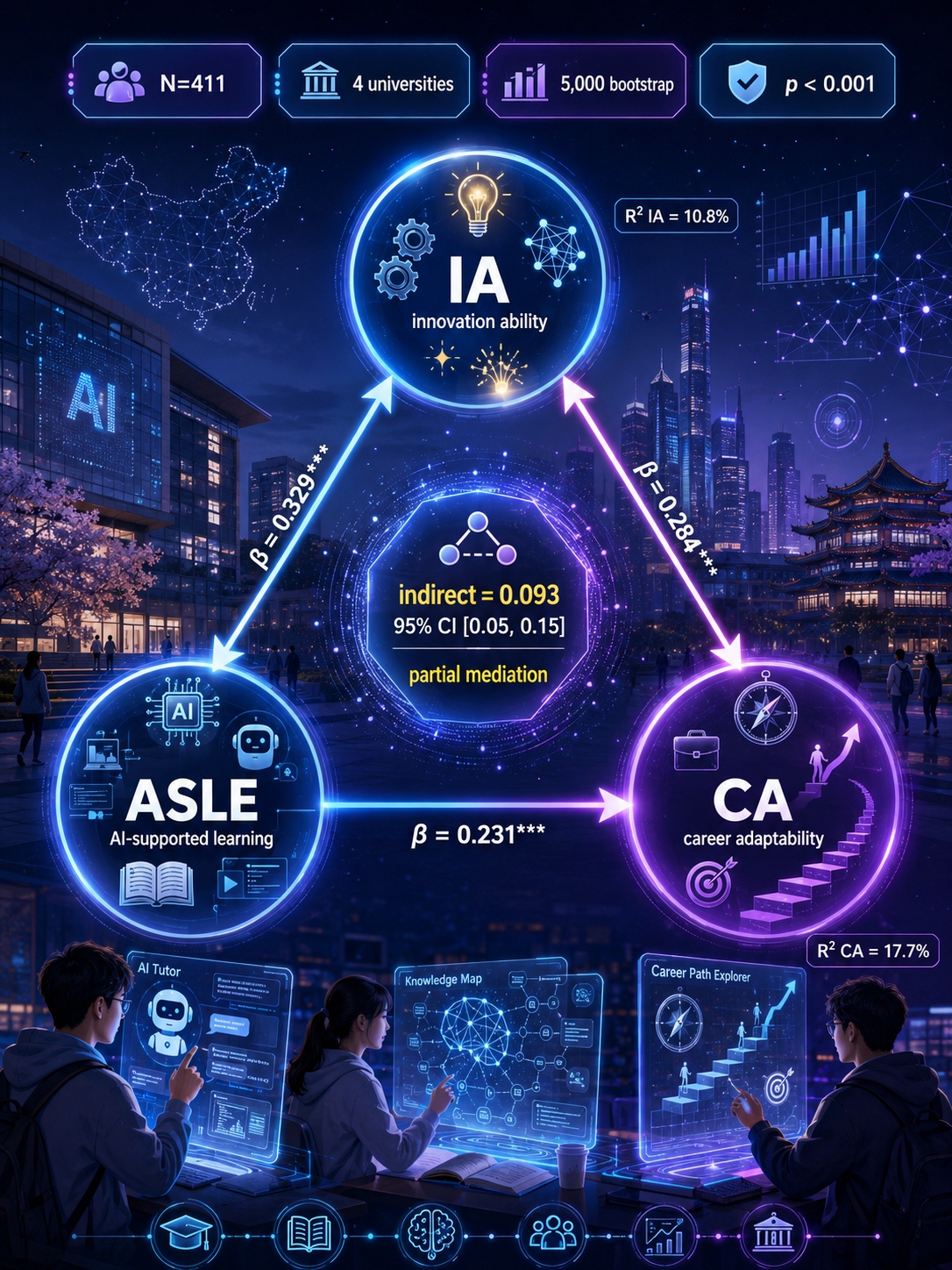
Artificial intelligence (AI) is increasingly embedded in higher education, yet empirical evidence remains limited regarding whether students’ AI-Supported Learning Experience (ASLE) is associated with broader developmental outcomes such as innovation ability and career adaptability within a single explanatory model. This study employed a quantitative cross-sectional survey design involving 411 undergraduate students from four universities in China who had prior exposure to AI-supported learning environments. Data were analyzed using IBM SPSS and AMOS through descriptive statistics, reliability testing, confirmatory factor analysis (CFA), structural equation modelling (SEM), and bootstrapped mediation analysis with 5,000 resamples. The findings indicate that ASLE positively predicts innovation ability (β = 0.329, p < 0.001) and career adaptability (β = 0.231, p < 0.001). Innovation ability also positively predicts career adaptability (β = 0.284, p < 0.001). In addition, innovation ability significantly partially mediates the relationship between ASLE and career adaptability (indirect effect = 0.093, p < 0.001; 95% CI [0.05, 0.15]). The model explained 10.8% of the variance in innovation ability and 17.7% of the variance in career adaptability. The study suggests that AI-supported learning in higher education may contribute to students’ future-oriented development not only by familiarizing them with emerging technologies, but also by strengthening innovation-related capability that supports adaptive career readiness. The findings clarify the construct boundary of ASLE and highlight the importance of pedagogically meaningful AI integration in designing learning environments that better prepare students for technology-driven labor markets.
Downloads
Article Details

This work is licensed under a Creative Commons Attribution-ShareAlike 4.0 International License.
Authors who publish with this journal agree to the following terms:
- Copyright of the published article belongs to the authors and grant the journal right of first publication with the work simultaneously licensed under a Creative Commons Attribution-ShareAlike 4.0 (CC BY SA) International License that allows others to share the work with an acknowledgment of the work's authorship and initial publication in this journal.
- Authors are able to enter into separate, additional contractual arrangements for the non-exclusive distribution of the journal's published version of the work (e.g., post it to an institutional repository or publish it in a book), with an acknowledgment of its initial publication in this journal.
- Authors are permitted and encouraged to post their work online (e.g., in institutional repositories or on their website) prior to and during the submission process, as it can lead to productive exchanges, as well as earlier and greater citation of published work (See the Effect of Open Access).
References
[1] M. Bond et al., “A meta systematic review of artificial intelligence in higher education: a call for increased ethics, collaboration, and rigour,” Int. J. Educ. Technol. High. Educ., vol. 21, no. 1, p. 4, 2024, https://doi.org/10.1186/s41239-023-00436-z
[2] S. Wang, F. Wang, Z. Zhu, J. Wang, T. Tran, and Z. Du, “Artificial intelligence in education: A systematic literature review,” Expert Syst. Appl., vol. 252, no. Part A, p. 124167, 2024, https://doi.org/10.1016/j.eswa.2024.124167
[3] H. Crompton and D. Burke, “Artificial intelligence in higher education: the state of the field,” Int. J. Educ. Technol. High. Educ., vol. 20, no. 1, pp. 1–22, 2023, https://doi.org/10.1186/s41239-023-00392-8
[4] J. Southworth et al., “Developing a model for AI Across the curriculum: Transforming the higher education landscape via innovation in AI literacy,” Comput. Educ. Artif. Intell., vol. 4, p. 100127, 2023, https://doi.org/10.1016/j.caeai.2023.100127
[5] C. K. Y. Chan, “A comprehensive AI policy education framework for university teaching and learning,” Int. J. Educ. Technol. High. Educ., vol. 20, no. 1, p. 38, 2023, https://doi.org/10.1186/s41239-023-00408-3
[6] B. N. Abbasi, Y. Wu, and Z. Luo, “Exploring the impact of artificial intelligence on curriculum development in global higher education institutions,” Educ. Inf. Technol., vol. 30, no. 1, pp. 547–581, 2025, https://doi.org/10.1007/s10639-024-13113-z
[7] B. Memarian and T. Doleck, “Teaching and learning artificial intelligence: Insights from the literature,” Educ. Inf. Technol., vol. 29, no. 16, pp. 21523–21546, 2024, https://doi.org/10.1007/s10639-024-12679-y
[8] B. L. Muna, S. Sudianto, and M. L. L. Usman, “Siakif-Bots: Gemini Ai for Academic Service Chatbots,” J. Appl. Eng. Technol. Sci., vol. 6, no. 2, pp. 1237–1253, 2025, https://doi.org/10.37385/jaets.v6i2.6728
[9] U. A. A. Rauf, M. M. Deli, and N. Husin, “From Exclusion To Empowerment: Redesigning E-Learning To Mitigate Risks for Disabled Students,” J. Appl. Eng. Technol. Sci., vol. 7, no. 1, pp. 129–143, 2025, https://doi.org/10.37385/jaets.v7i1.7608
[10] O. Zawacki-Richter, V. I. Marín, M. Bond, and F. Gouverneur, “Systematic review of research on artificial intelligence applications in higher education – where are the educators?,” Int. J. Educ. Technol. High. Educ., vol. 16, no. 1, p. 39, 2019, https://doi.org/10.1186/s41239-019-0171-0
[11] M. L. Savickas and E. J. Porfeli, “Career Adapt-Abilities Scale: Construction, reliability, and measurement equivalence across 13 countries,” J. Vocat. Behav., vol. 80, no. 3, pp. 661–673, 2012, https://doi.org/10.1016/j.jvb.2012.01.011
[12] M. Haenggli and A. Hirschi, “Career adaptability and career success in the context of a broader career resources framework,” J. Vocat. Behav., vol. 119, p. 103414, 2020, https://doi.org/10.1016/j.jvb.2020.103414
[13] J. Rossier, M. C. Ginevra, G. Bollmann, and L. Nota, “The importance of career adaptability, career resilience, and employability in designing a successful life,” in Psychology of Career Adaptability, Employability and Resilience, Springer, 2017, pp. 65–82. https://doi.org/10.1007/978-3-319-66954-0_5
[14] M. E. Duarte, J. T. da Silva, and M. P. Paixão, “Career adaptability, employability, and career resilience in managing transitions,” in Psychology of Career Adaptability, Employability and Resilience, Springer, 2017, pp. 241–261. https://doi.org/10.1007/978-3-319-66954-0_15
[15] F. Ouyang and P. Jiao, “Artificial intelligence in education: The three paradigms,” Comput. Educ. Artif. Intell., vol. 2, p. 100020, 2021, https://doi.org/10.1016/j.caeai.2021.100020
[16] H. Lin and Q. Chen, “Artificial intelligence (AI) -integrated educational applications and college students’ creativity and academic emotions: students and teachers’ perceptions and attitudes,” BMC Psychol., vol. 12, no. 1, p. 487, 2024, https://doi.org/10.1186/s40359-024-01979-0
[17] H.-B. Sheu and L. Phrasavath, “Social cognitive career theory,” Contemp. Theor. Career Dev., vol. 4, no. 1, pp. 47–60, 2019, https://doi.org/10.4324/9781315276175-6
[18] R. M. Ryan and E. L. Deci, “Self-determination theory and the facilitation of intrinsic motivation, social development, and well-being,” Am. Psychol., vol. 55, no. 1, pp. 68–78, 2000, https://doi.org/10.1037/0003-066X.55.1.68
[19] R. M. Ryan and E. L. Deci, “Intrinsic and Extrinsic Motivations: Classic Definitions and New Directions,” Contemp. Educ. Psychol., vol. 25, no. 1, pp. 54–67, 2000, https://doi.org/10.1006/ceps.1999.1020
[20] E. L. Deci and R. M. Ryan, “The ‘what’ and ‘why’ of goal pursuits: Human needs and the self-determination of behavior,” Psychol. Inq., vol. 11, no. 4, pp. 227–268, 2000, https://doi.org/10.1207/S15327965PLI1104_01
[21] G. M. Idroes et al., “Student Perspectives on the Role of Artificial Intelligence in Education: A Survey-Based Analysis,” J. Educ. Manag. Learn., vol. 1, no. 1, pp. 8–15, 2023, https://doi.org/10.60084/jeml.v1i1.58
[22] F. Amastini, D. K. S. Sekarhati, and M. Puspitasari, “Advancing Adaptive and Personalized E-Learning Systems: A Systematic Literature Review,” Adv. Sustain. Sci. Eng. Technol., vol. 7, no. 2, 2025, https://doi.org/10.26877/m82zg802
[23] F. Ouyang, L. Zheng, and P. Jiao, “Artificial intelligence in online higher education: A systematic review of empirical research from 2011 to 2020,” Educ. Inf. Technol., vol. 27, no. 6, pp. 7893–7925, 2022, https://doi.org/10.1007/s10639-022-10925-9
[24] M. E. Dogan, T. Goru Dogan, and A. Bozkurt, “The Use of Artificial Intelligence (AI) in Online Learning and Distance Education Processes: A Systematic Review of Empirical Studies,” Appl. Sci., vol. 13, no. 5, p. 3056, 2023, https://doi.org/10.3390/app13053056
[25] M. D. Adewale, A. Azeta, A. Abayomi-Alli, and A. Sambo-Magaji, “Impact of artificial intelligence adoption on students’ academic performance in open and distance learning: A systematic literature review,” Heliyon, vol. 10, no. 22, 2024, https://doi.org/10.1016/j.heliyon.2024.e40025
[26] Ramesh C. Sharma, A. Bozkurt, and Paul Kawachi, “The Landscape of Artificial Intelligence in Open, Online and DistanceEducation: Promises and Concerns,” Asian J. Distance Educ., vol. 14, no. 2, pp. 497–514, 2019.
[27] Í. M. Oliveira and C. Marques, “The Role of Career Adaptability and Academic Engagement in College Student’s Life Satisfaction,” Int. J. Environ. Res. Public Health, vol. 21, no. 5, p. 596, 2024, https://doi.org/10.3390/ijerph21050596
[28] M. Fang, R. Pan, R. Ding, Z. Hou, and D. Wang, “Effect of proactive personality on career adaptability of higher vocational college students: the mediating role of college experience,” Front. Psychol., vol. 15, p. 1333677, 2024, https://doi.org/10.3389/fpsyg.2024.1333677
[29] C. Pang, R. Xie, N. Kang, and Z. Hu, “The Impact of Career Education Participation on Academic Self-Efficacy: The Sequential Mediating Role of Career Adaptability and Learning Engagement,” Behav. Sci. (Basel)., vol. 15, no. 2, p. 174, 2025, https://doi.org/10.3390/bs15020174
[30] H. C. Portocarrero Ramos et al., “Artificial intelligence skills and their impact on the employability of university graduates,” Front. Artif. Intell., vol. 8, p. 1629320, 2025, https://doi.org/10.3389/frai.2025.1629320
[31] M. M. Asad and K. Anwar, “Influence of artificial intelligence on students’ career competencies and career resources: a global perspective,” Int. J. Inf. Learn. Technol., vol. 42, no. 4, pp. 366–391, 2025, https://doi.org/10.1108/IJILT-05-2024-0091
[32] X. Wang, S. Zhao, X. Xu, H. Zhang, and V. N. L. Lei, “AI adoption in Chinese universities: Insights, challenges, and opportunities from academic leaders,” Acta Psychol. (Amst)., vol. 258, p. 105160, 2025, https://doi.org/10.1016/j.actpsy.2025.105160
[33] Y. Zhang, M. Zhang, L. Wu, and J. Li, “Digital Transition Framework for Higher Education in AI-Assisted Engineering Teaching: Challenge, Strategy, and Initiatives in China,” Sci. Educ., vol. 34, no. 2, pp. 933–954, 2025, https://doi.org/10.1007/s11191-024-00575-3
[34] Y. Huang, J. Zhang, Y. Xu, and Y. Bu, “How can digital innovation capabilities of Chinese college students be cultivated?,” Int. J. Manag. Educ., vol. 22, no. 3, p. 101085, 2024, https://doi.org/10.1016/j.ijme.2024.101085
[35] Y. Ma and D. Bennett, “Analyzing predictors of perceived graduate employability from sufficiency and necessity perspectives,” High. Educ., vol. 88, no. 6, pp. 2375–2397, 2024, https://doi.org/10.1007/s10734-024-01221-1
[36] Ministry of Education of the People’s Republic of China, “MOE outlines 2025 national strategy for digital education,” Ministry of Education of the People’s Republic of China, 2025. http://en.moe.gov.cn/news/press_releases/202504/t20250403_1186060.html?
[37] O. Zawacki-Richter, V. I. Marín, M. Bond, and F. Gouverneur, “Systematic review of research on artificial intelligence applications in higher education – where are the educators?,” Int. J. Educ. Technol. High. Educ., vol. 16, no. 1, pp. 1–27, 2019, https://doi.org/10.1186/s41239-019-0171-0
[38] T. Bates, C. Cobo, O. Mariño, and S. Wheeler, “Can artificial intelligence transform higher education?,” Int. J. Educ. Technol. High. Educ., vol. 17, no. 1, p. 42, 2020, https://doi.org/10.1186/s41239-020-00218-x
[39] L. Kuka, C. Hörmann, and B. Sabitzer, “Teaching and Learning with AI in Higher Education: A Scoping Review,” Lect. Notes Networks Syst., vol. 456, pp. 551–571, 2022, https://doi.org/10.1007/978-3-031-04286-7_26
[40] O. Noroozi, M. Khalil, and S. K. Banihashem, “Artificial Intelligence in higher education: Impact depends on support, pedagogy, human agency, and purpose,” Innovations in Education and Teaching International, vol. 62, no. 5. Taylor & Francis, pp. 1425–1430, 2025. https://doi.org/10.1080/14703297.2025.2539579
[41] A. Katalinic, V. Slavuj, and D. Jaksic, “Artificial Intelligence in Online Education: A Systematic Review of Its Impact on Learner Engagement and Satisfaction,” in Education Sciences, 2026, vol. 16, no. 3, p. 1648661. https://doi.org/10.3390/educsci16030389
[42] D. Y. Long, S. Wang, S. Md Rashid, and X. T. Lu, “Artificial intelligence in higher education: a systematic review of its impact on student engagement and the mediating role of teaching methods,” in Frontiers in Education, 2026, vol. 10, p. 1648661. https://doi.org/10.3389/feduc.2025.1648661
[43] X. Li, X. Weng, and Q. Qu, “Technology-enhanced creativity and entrepreneurship curricula in higher education: Systematic review from the perspective of self-determination theory,” Think. Ski. Creat., p. 102144, 2026, https://doi.org/10.1016/j.tsc.2026.102144
[44] S. Alateyyat and M. Soltan, “Utilizing Artificial Intelligence in Higher Education: A Systematic Review,” in 2024 ASU International Conference in Emerging Technologies for Sustainability and Intelligent Systems, ICETSIS 2024, 2024, pp. 371–374. https://doi.org/10.1109/ICETSIS61505.2024.10459629
[45] I. M. Castillo-Martínez, D. Flores-Bueno, S. M. Gómez-Puente, and V. O. Vite-León, “AI in higher education: A systematic literature review,” in Frontiers in Education, 2024, vol. 9, p. 1391485. https://doi.org/10.3389/feduc.2024.1391485
[46] R. W. Lent, S. D. Brown, and G. Hackett, “Toward a Unifying Social Cognitive Theory of Career and Academic Interest, Choice, and Performance,” J. Vocat. Behav., vol. 45, no. 1, pp. 79–122, 1994, https://doi.org/10.1006/jvbe.1994.1027
[47] R. W. Lent, G. W. Ireland, L. T. Penn, T. R. Morris, and R. Sappington, “Sources of self-efficacy and outcome expectations for career exploration and decision-making: A test of the social cognitive model of career self-management,” J. Vocat. Behav., vol. 99, pp. 107–117, 2017, https://doi.org/10.1016/j.jvb.2017.01.002
[48] C.-Y. Huang, S.-J. Lou, Y.-M. Cheng, and C.-C. Chung, “Research on teaching a welding implementation course assisted by sustainable virtual reality technology,” Sustain., vol. 12, no. 23, pp. 1–21, 2020, https://doi.org/10.3390/su122310044
[49] N. Q. T. Vo, P. K. T. Tran, and D. H. T. Nguyen, “How experiential learning and AI readiness foster career adaptation in hospitality and tourism education,” J. Tour. Futur., pp. 1–21, 2026, https://doi.org/10.1108/JTF-10-2025-0312
[50] K. S. S. S. Ray, D. M. Mahapatra, B. L. Rout, and Z. H. Shaikh, “AI and the Future of Foundational Learning: How Can AI Support Lifelong Learning and Prepare Learners for the Evolving Global Workforce?,” in Cases on AI-Driven Talent Economy and Human Capital, IGI Global Scientific Publishing, 2026, pp. 1–30. https://doi.org/10.4018/979-8-3373-3867-5.ch001
[51] X. Ye, W. Zhang, Y. Zhou, X. Li, and Q. Zhou, “Improving students’ programming performance: an integrated mind mapping and generative AI chatbot learning approach,” Humanit. Soc. Sci. Commun., vol. 12, no. 1, pp. 1–13, 2025, https://doi.org/10.1057/s41599-025-04846-4
[52] G. W. Cheung, H. D. Cooper-Thomas, R. S. Lau, and L. C. Wang, “Reporting reliability, convergent and discriminant validity with structural equation modeling: A review and best-practice recommendations,” Asia Pacific J. Manag., vol. 41, no. 2, pp. 745–783, 2024, https://doi.org/10.1007/s10490-023-09871-y
[53] C. Fornell and D. F. Larcker, “Evaluating Structural Equation Models with Unobservable Variables and Measurement Error,” J. Mark. Res., vol. 18, no. 1, p. 39, 1981, https://doi.org/10.2307/3151312
[54] F. Balabdaoui, N. Dittmann-Domenichini, H. Grosse, C. Schlienger, and G. Kortemeyer, “A survey on students’ use of AI at a technical university,” Discov. Educ., vol. 3, no. 1, p. 51, 2024, https://doi.org/10.1007/s44217-024-00136-4
[55] J. Heil, D. Ifenthaler, M. Cooper, M. L. Mascia, R. Conti, and M. P. Penna, “Students’ perceived impact of GenAI tools on learning and assessment in higher education: the role of individual AI competence,” Smart Learn. Environ., vol. 12, no. 1, p. 37, 2025, https://doi.org/10.1186/s40561-025-00395-0
[56] B. S. Selznick and M. J. Mayhew, “Measuring Undergraduates’ Innovation Capacities,” Res. High. Educ., vol. 59, no. 6, pp. 744–764, 2018, https://doi.org/10.1007/s11162-017-9486-7
[57] M. Keinänen, J. Ursin, and K. Nissinen, “How to measure students’ innovation competences in higher education: Evaluation of an assessment tool in authentic learning environments,” Stud. Educ. Eval., vol. 58, pp. 30–36, 2018, https://doi.org/10.1016/j.stueduc.2018.05.007
[58] M. M. Keinänen and L. Kairisto-Mertanen, “Researching learning environments and students’ innovation competences,” Educ. Train., vol. 61, no. 1, pp. 17–30, 2019, https://doi.org/10.1108/ET-03-2018-0064
[59] C. Maggiori, J. Rossier, and M. L. Savickas, “Career adapt-abilities scale–short form (CAAS-SF) construction and validation,” J. career Assess., vol. 25, no. 2, pp. 312–325, 2017.
[60] H. Yu, Y. Dai, X. Guan, and W. Wang, “Career Adapt-Abilities Scale–Short Form (CAAS-SF): Validation Across Three Different Samples in the Chinese Context,” J. Career Assess., vol. 28, no. 2, pp. 219–240, 2020, https://doi.org/10.1177/1069072719850575
[61] J. E. Collier, Applied structural equation modeling using amos: Basic to advanced techniques. Routledge, 2020. https://doi.org/10.4324/9781003018414
[62] J. F. Hair, M. C. Howard, and C. Nitzl, “Assessing measurement model quality in PLS-SEM using confirmatory composite analysis,” J. Bus. Res., vol. 109, pp. 101–110, 2020, https://doi.org/10.1016/j.jbusres.2019.11.069
[63] P. M. Bentler and D. G. Bonett, “Significance tests and goodness of fit in the analysis of covariance structures,” Psychol. Bull., vol. 88, no. 3, pp. 588–606, 1980, https://doi.org/10.1037/0033-2909.88.3.588
[64] S. Mulaik, “There is a place for approximate fit in structural equation modelling,” Pers. Individ. Dif., vol. 42, no. 5, pp. 883–891, 2007, https://doi.org/10.1016/j.paid.2006.10.024
[65] H. W. Marsh, K. T. Hau, and D. Grayson, “Goodness of fit in structural equation models,” Contemp. Psychom. A Festschrift Roderick P.McDonald, pp. 276–335, 2013, https://doi.org/10.4324/9781410612977
[66] R. E. Schumacker and R. G. Lomax, A Beginner’s Guide to Structural Equation Modeling, 3rd ed. Mahwah, NJ: Lawrence Erlbaum Associates, 2015. https://doi.org/10.4324/9781315749105
[67] R. B. Kline, Principles and practice of structural equation modeling. Guilford publications, 2023.
[68] L. Y. Tan, S. Hu, D. J. Yeo, and K. H. Cheong, “Artificial intelligence-enabled adaptive learning platforms: A review,” Comput. Educ. Artif. Intell., vol. 9, p. 100429, 2025, https://doi.org/10.1016/j.caeai.2025.100429
[69] I. Gligorea, M. Cioca, R. Oancea, A. T. Gorski, H. Gorski, and P. Tudorache, “Adaptive Learning Using Artificial Intelligence in e-Learning: A Literature Review,” Educ. Sci., vol. 13, no. 12, p. 1216, 2023, https://doi.org/10.3390/educsci13121216
[70] D. A. Schmidt, B. Alboloushi, A. Thomas, and R. Magalhaes, “Integrating artificial intelligence in higher education: perceptions, challenges, and strategies for academic innovation,” Comput. Educ. Open, vol. 9, p. 100274, 2025, https://doi.org/10.1016/j.caeo.2025.100274
[71] C. W. Rudolph, K. N. Lavigne, and H. Zacher, “Career adaptability: A meta-analysis of relationships with measures of adaptivity, adapting responses, and adaptation results,” J. Vocat. Behav., vol. 98, pp. 17–34, 2017, https://doi.org/10.1016/j.jvb.2016.09.002
[72] M. L. Savickas, “The theory and practice of career construction,” Career Couns., pp. 192–202, 2020, https://doi.org/10.4324/9781315693590-26
[73] S. C. Kong, M. Y. W. Cheung, and O. Tsang, “Developing an artificial intelligence literacy framework: Evaluation of a literacy course for senior secondary students using a project-based learning approach,” Comput. Educ. Artif. Intell., vol. 6, p. 100214, 2024, https://doi.org/10.1016/j.caeai.2024.100214
[74] D. T. K. Ng, J. Su, J. K. L. Leung, and S. K. W. Chu, “Artificial intelligence (AI) literacy education in secondary schools: a review,” Interact. Learn. Environ., vol. 32, no. 10, pp. 6204–6224, 2024, https://doi.org/10.1080/10494820.2023.2255228
[75] X. Li, R. Pu, and H. Liao, “The impacts of innovation capability and social adaptability on undergraduates’ employability: The role of self-efficacy,” Front. Psychol., vol. 13, p. 954828, 2022, https://doi.org/10.3389/fpsyg.2022.954828
[76] A. Hirschi, A. Herrmann, and A. C. Keller, “Career adaptivity, adaptability, and adapting: A conceptual and empirical investigation,” J. Vocat. Behav., vol. 87, pp. 1–10, 2015, https://doi.org/10.1016/j.jvb.2014.11.008
[77] B. Cooper, N. Eva, F. Zarea Fazlelahi, A. Newman, A. Lee, and M. Obschonka, “Addressing common method variance and endogeneity in vocational behavior research: A review of the literature and suggestions for future research,” J. Vocat. Behav., vol. 121, p. 103472, 2020, https://doi.org/10.1016/j.jvb.2020.103472
[78] R. M. Agoes Salim, M. R. Istiasih, N. A. Rumalutur, and D. D. Biondi Situmorang, “The role of career decision self-efficacy as a mediator of peer support on students’ career adaptability,” Heliyon, vol. 9, no. 4, 2023, https://doi.org/10.1016/j.heliyon.2023.e14911
[79] J. Soares and M. do C. Taveira, “Career adaptation in higher education: a study with non-working and working students,” in Frontiers in Education, 2024, vol. 9, p. 1314663. https://doi.org/10.3389/feduc.2024.1314663
[80] UNESCO, AI and the future of education: Disruptions, dilemmas and directions. Paris: UNESCO, 2025. https://doi.org/10.54675/keck1261
[81] R. R. Wang, “Not just a plus: rethinking the ‘AI + Education’ illusion,” AI Soc., vol. 41, no. 1, pp. 475–476, 2025, https://doi.org/10.1007/s00146-025-02458-9