
Service Quality and Perceived Platform Error Exposure in Digital Learning Platforms: An Extended SEM Study of Perceived Value and Continuance Intentions in Indonesia and Malaysia
Article Sidebar
Main Article Content
Abstract
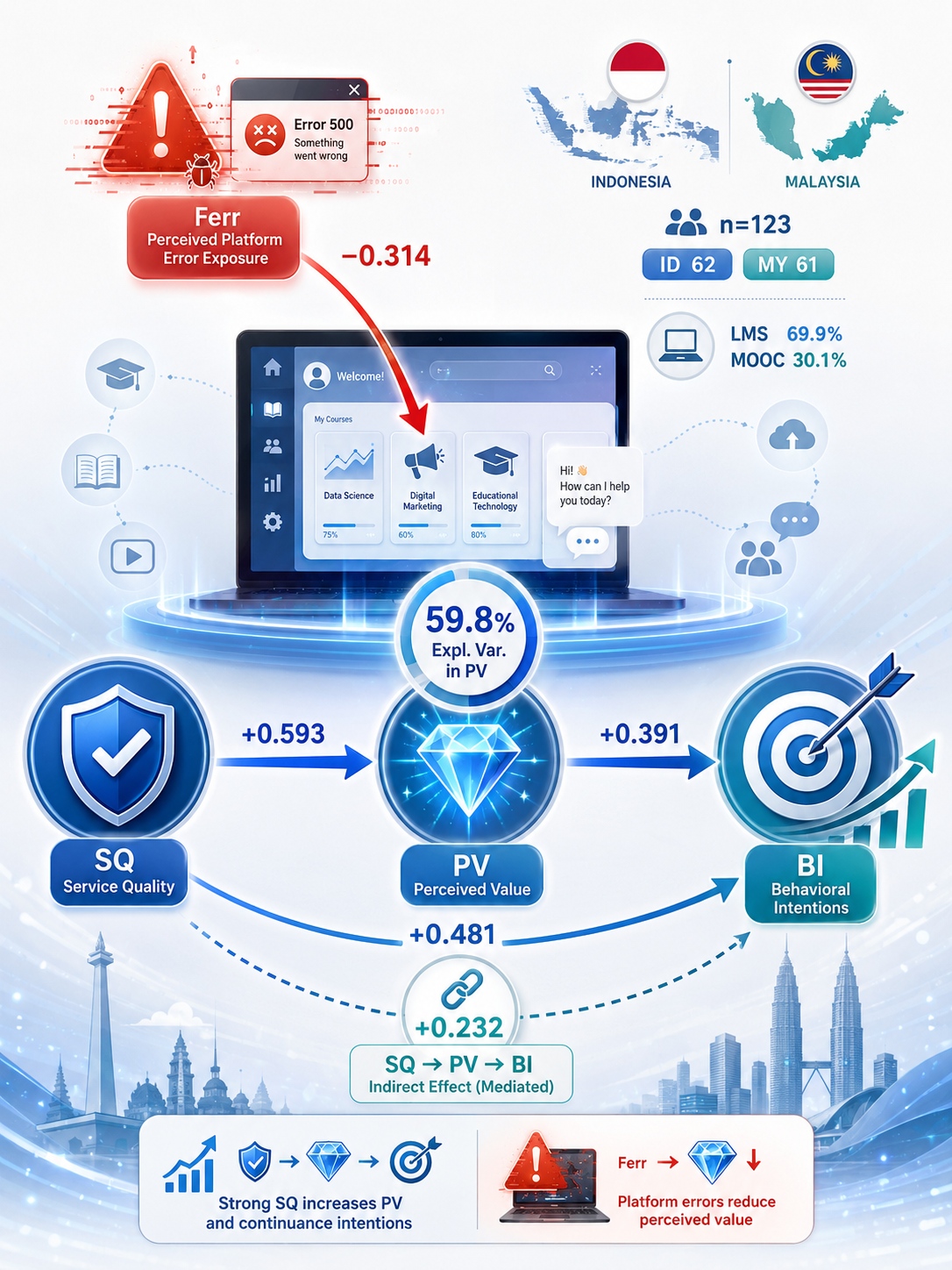
Digital learning platforms have become essential academic service systems in higher education, yet e-learning continuance research has largely emphasized positive quality attributes while under examining recurring technical disruptions. This study investigates how service quality and perceived platform error exposure influence perceived value and behavioral intentions among university students in Indonesia and Malaysia. Drawing on the Information Systems Success Model, SERVQUAL, and post-adoption continuance theory, an extended structural equation modelling framework was tested using cross-sectional survey data from 123 undergraduate students, comprising 62 respondents from Indonesia and 61 from Malaysia. The sample included LMS users (69.9%) and MOOC users (30.1%). Data were analyzed using confirmatory factor analysis and SEM in IBM AMOS. The measurement model showed good fit: χ²/df = 1.74, CFI = 0.961, TLI = 0.954, RMSEA = 0.048, and SRMR = 0.042. In the extended model, service quality positively predicted perceived value (β = 0.593, p < 0.001) and behavioral intentions (β = 0.481, p < 0.001), while perceived value positively predicted behavioral intentions (β = 0.391, p < 0.001). Perceived platform error exposure negatively predicted perceived value (β = −0.314, p < 0.001), and perceived value significantly mediated the service quality–behavioral intention relationship (β = 0.232, p < 0.001). The extended model explained 59.8% of the variance in perceived value and improved model fit relative to the baseline model. These findings position platform error exposure as a distinct negative user-experience construct and highlight the need to improve service quality while reducing recurring technical failures.
Downloads
Article Details

This work is licensed under a Creative Commons Attribution-ShareAlike 4.0 International License.
Authors who publish with this journal agree to the following terms:
- Copyright of the published article belongs to the authors and grant the journal right of first publication with the work simultaneously licensed under a Creative Commons Attribution-ShareAlike 4.0 (CC BY SA) International License that allows others to share the work with an acknowledgment of the work's authorship and initial publication in this journal.
- Authors are able to enter into separate, additional contractual arrangements for the non-exclusive distribution of the journal's published version of the work (e.g., post it to an institutional repository or publish it in a book), with an acknowledgment of its initial publication in this journal.
- Authors are permitted and encouraged to post their work online (e.g., in institutional repositories or on their website) prior to and during the submission process, as it can lead to productive exchanges, as well as earlier and greater citation of published work (See the Effect of Open Access).
References
[1] A. O. Mohmmed, B. A. Khidhir, A. Nazeer, and V. J. Vijayan, “Emergency remote teaching during Coronavirus pandemic: the current trend and future directive at Middle East College Oman,” Innov. Infrastruct. Solut., vol. 5, no. 3, p. 72, 2020, https://doi.org/10.1007/s41062-020-00326-7
[2] D. R. Garrison and H. Kanuka, “Blended learning: Uncovering its transformative potential in higher education,” Internet High. Educ., vol. 7, no. 2, pp. 95–105, 2004, https://doi.org/10.1016/j.iheduc.2004.02.001
[3] C. B. Hodges, S. Moore, B. B. Lockee, T. Trust, and M. A. Bond, “The difference between emergency remote teaching and online learning,” Handb. Res. Online Learn. Insights Adv., vol. 27, no. 1, pp. 511–522, 2024, https://doi.org/10.1163/9789004702813_021
[4] K. A. Pituch and Y. kuei Lee, “The influence of system characteristics on e-learning use,” Comput. Educ., vol. 47, no. 2, pp. 222–244, 2006, https://doi.org/10.1016/j.compedu.2004.10.007
[5] H. M. Selim, “Critical success factors for e-learning acceptance: Confirmatory factor models,” Comput. Educ., vol. 49, no. 2, pp. 396–413, 2007, https://doi.org/10.1016/j.compedu.2005.09.004
[6] S. Ozkan and R. Koseler, “Multi-dimensional evaluation of E-learning systems in the higher education context: An empirical investigation of a computer literacy course,” Proc. - Front. Educ. Conf. FIE, vol. 53, no. 4, pp. 1285–1296, 2009, https://doi.org/10.1109/FIE.2009.5350590
[7] S. S. Liaw, “Investigating students’ perceived satisfaction, behavioral intention, and effectiveness of e-learning: A case study of the Blackboard system,” Comput. Educ., vol. 51, no. 2, pp. 864–873, 2008, https://doi.org/10.1016/j.compedu.2007.09.005
[8] C. Thangave et al., “Students’ Activeness Measure in Moodle Learning Management System Using Machine Learning,” J. Appl. Eng. Technol. Sci., vol. 6, no. 1, pp. 744–753, 2024, https://doi.org/10.37385/jaets.v6i1.6128
[9] W. H. DeLone and E. R. McLean, “The DeLone and McLean model of information systems success: A ten-year update,” J. Manag. Inf. Syst., vol. 19, no. 4, pp. 9–30, 2003, https://doi.org/10.1080/07421222.2003.11045748
[10] N. Urbach and B. Müller, “The Updated DeLone and McLean Model of Information Systems Success,” in Information Systems Theory: Explaining and Predicting Our Digital Society, Vol. 1, Springer, 2012, pp. 1–18. https://doi.org/10.1007/978-1-4419-6108-2_1
[11] S. Petter, W. DeLone, and E. McLean, “Measuring information systems success: Models, dimensions, measures, and interrelationships,” Eur. J. Inf. Syst., vol. 17, no. 3, pp. 236–263, 2008, https://doi.org/10.1057/ejis.2008.15
[12] R. D. Freeze, K. a Alshare, P. L. Lane, and H. Joseph Wen, “IS success model in e-learning context based on students’ perceptions,” J. Inf. Syst. Educ., vol. 21, no. 2, p. 173, 2010. https://jise.org/Volume21/n2/JISEv21n2p173.html
[13] W. A. Cidral, T. Oliveira, M. Di Felice, and M. Aparicio, “E-learning success determinants: Brazilian empirical study,” Comput. Educ., vol. 122, pp. 273–290, 2018, https://doi.org/10.1016/j.compedu.2017.12.001
[14] A. Hassanzadeh, F. Kanaani, and S. Elahi, “A model for measuring e-learning systems success in universities,” Expert Syst. Appl., vol. 39, no. 12, pp. 10959–10966, 2012. https://doi.org/10.1016/j.eswa.2012.03.028
[15] P. C. Sun, R. J. Tsai, G. Finger, Y. Y. Chen, and D. Yeh, “What drives a successful e-Learning? An empirical investigation of the critical factors influencing learner satisfaction,” Comput. Educ., vol. 50, no. 4, pp. 1183–1202, May 2008. https://doi.org/10.1016/j.compedu.2006.11.007
[16] Z. Shi and H. Shang, “A review on quality of service and servqual model,” in Lecture Notes in Computer Science (including subseries Lecture Notes in Artificial Intelligence and Lecture Notes in Bioinformatics), 2020, vol. 12204 LNCS, pp. 188–204. https://doi.org/10.1007/978-3-030-50341-3_15
[17] A. Parasuraman, V. A. Zeithaml, and L. L. Berry, “SERVQUAL: A multiple-item scale for measuring consumer perceptions of service quality,” J. Retail., vol. 64, no. 1, pp. 12–40, 1988. https://www.econbiz.de/10001056853
[18] J. J. Cronin, M. K. Brady, and G. T. M. Hult, “Assessing the effects of quality, value, and customer satisfaction on consumer behavioral intentions in service environments,” J. Retail., vol. 76, no. 2, pp. 193–218, 2000, https://doi.org/10.1016/S0022-4359(00)00028-2
[19] R. Novendra, N. Jalinus, Waskito, Afriansyah, and A. Rasfira, “User Satisfaction Analysis of Service Quality of Dapodik Applications (Educational Data) Using Servqual Method,” J. Appl. Eng. Technol. Sci., vol. 3, no. 2, pp. 190–194, 2022, https://doi.org/10.37385/jaets.v3i2.790
[20] D. Al-Fraihat, M. Joy, and J. Sinclair, “Evaluating E-learning systems success: An empirical study,” Comput. Human Behav., vol. 102, pp. 67–86, 2020. https://doi.org/10.1016/j.chb.2019.08.004
[21] A. Y. Alsabawy, A. Cater-Steel, and J. Soar, “Determinants of perceived usefulness of e-learning systems,” Comput. Human Behav., vol. 64, pp. 843–858, 2016, https://doi.org/10.1016/j.chb.2016.07.065
[22] L. Pham, Y. B. Limbu, T. K. Bui, H. T. Nguyen, and H. T. Pham, “Does e-learning service quality influence e-learning student satisfaction and loyalty? Evidence from Vietnam,” Int. J. Educ. Technol. High. Educ., vol. 16, no. 1, pp. 1–26, 2019, https://doi.org/10.1186/s41239-019-0136-3
[23] J. C. Sweeney and G. N. Soutar, “Consumer perceived value: The development of a multiple item scale,” J. Retail., vol. 77, no. 2, pp. 203–220, 2001, https://doi.org/10.1016/S0022-4359(01)00041-0
[24] R. B. Woodruff, “Customer value: The next source for competitive advantage,” J. Acad. Mark. Sci., vol. 25, no. 2, pp. 139–153, 1997, https://doi.org/10.1007/BF02894350
[25] M. C. Kim, M. J. Hannafin, and L. A. Bryan, “Technology-enhanced inquiry tools in science education: An emerging pedagogical framework for classroom practice,” Sci. Educ., vol. 91, no. 6, pp. 1010–1030, 2007, https://doi.org/10.1002/sce.20219
[26] R. L. Oliver, “A Cognitive Model of the Antecedents and Consequences of Satisfaction Decisions,” J. Mark. Res., vol. 17, no. 4, p. 460, 1980, https://doi.org/10.2307/3150499
[27] M. A. Hossain and M. Quaddus, “Expectation–Confirmation Theory in Information System Research: A Review and Analysis,” Inf. Syst. theory Explain. Predict. our Digit. Soc. Vol. 1, pp. 441–469, 2012, https://doi.org/10.1007/978-1-4419-6108-2_21
[28] A. Bhattacherjee, “Understanding information systems continuance: An expectation-confirmation model,” MIS Q. Manag. Inf. Syst., vol. 25, no. 3, pp. 351–370, 2001, https://doi.org/10.2307/3250921
[29] C. M. Chiu, M. H. Hsu, S. Y. Sun, T. C. Lin, and P. C. Sun, “Usability, quality, value and e-learning continuance decisions,” Comput. Educ., vol. 45, no. 4, pp. 399–416, 2005, https://doi.org/10.1016/j.compedu.2004.06.001
[30] J. C. Roca, C.-M. Chiu, and F. J. Martínez, “Understanding e-learning continuance intention: An extension of the Technology Acceptance Model,” Int. J. Hum. Comput. Stud., vol. 64, no. 8, pp. 683–696, 2006. https://doi.org/10.1016/j.ijhcs.2006.01.003
[31] S. Petter and E. R. McLean, “A meta-analytic assessment of the DeLone and McLean IS success model: An examination of IS success at the individual level,” Inf. Manag., vol. 46, no. 3, pp. 159–166, 2009, https://doi.org/10.1016/j.im.2008.12.006
[32] R. Ayyagari, V. Grover, and R. Purvis, “Technostress: Technological antecedents and implications,” MIS Q. Manag. Inf. Syst., vol. 35, no. 4, pp. 831–858, 2011, https://doi.org/10.2307/41409963
[33] P. Sanjeeva Kumar, “TECHNOSTRESS: A comprehensive literature review on dimensions, impacts, and management strategies,” Comput. Hum. Behav. Reports, vol. 16, p. 100475, 2024, https://doi.org/10.1016/j.chbr.2024.100475
[34] S. C. Srivastava, S. Chandra, and A. Shirish, “Technostress creators and job outcomes: Theorising the moderating influence of personality traits,” Inf. Syst. J., vol. 25, no. 4, pp. 355–401, 2015, https://doi.org/10.1111/isj.12067
[35] M. Tarafdar, Q. Tu, and T. Ragu-Nathan, “Impact of technostress on end-user satisfaction and performance,” J. Manag. Inf. Syst., vol. 27, no. 3, pp. 303–334, 2010, https://doi.org/10.2753/MIS0742-1222270311
[36] B. Al-shargabi, O. Sabri, and S. Aljawarneh, “The adoption of an e-learning system using information systems success model: a case study of Jazan University,” PeerJ Comput. Sci., vol. 7, pp. 1–21, 2021, https://doi.org/10.7717/peerj-cs.723
[37] G. Chopra, P. Madan, P. Jaisingh, and P. Bhaskar, “Effectiveness of e-learning portal from students’ perspective: A structural equation model (SEM) approach,” Interact. Technol. Smart Educ., vol. 16, no. 2, pp. 94–116, 2019, https://doi.org/10.1108/ITSE-05-2018-0027
[38] F. Amastini, D. K. S. Sekarhati, and M. Puspitasari, “Advancing Adaptive and Personalized E-Learning Systems: A Systematic Literature Review,” Adv. Sustain. Sci. Eng. Technol., vol. 7, no. 2, 2025, https://doi.org/10.26877/m82zg802
[39] V. A. Zeithaml, L. L. Berry, and A. Parasuraman, “The Behavioral Consequences of Service Quality,” J. Mark., vol. 60, no. 2, pp. 31–46, 1996, https://doi.org/10.1177/002224299606000203
[40] T. J. McGill and J. E. Klobas, “A task-technology fit view of learning management system impact,” Comput. Educ., vol. 52, no. 2, pp. 496–508, 2009, https://doi.org/10.1016/j.compedu.2008.10.002
[41] P. D. Simon, J. Jiang, L. K. Fryer, R. B. King, and C. E. Frondozo, “An Assessment of Learning Management System Use in Higher Education: Perspectives from a Comprehensive Sample of Teachers and Students,” Technol. Knowl. Learn., vol. 30, no. 2, pp. 741–767, 2025, https://doi.org/10.1007/s10758-024-09734-5
[42] A. AL-Hawamleh, “Exploring the Satisfaction and Continuance Intention to Use E-Learning Systems,” Int. J. Electr. Comput. Eng. Syst., vol. 15, no. 2, pp. 201–214, 2024, https://doi.org/10.32985/ijeces.15.2.8
[43] M. A. Alterkait and M. Y. Alduaij, “Impact of Information Quality on Satisfaction with E-Learning Platforms: Moderating Role of Instructor and Learner Quality,” SAGE Open, vol. 14, no. 1, p. 21582440241233400, 2024, https://doi.org/10.1177/21582440241233400
[44] A. R. Alkhuwaylidee, “Exploring Factors Influencing Students’ Continuance Intention to Use E-Learning System for Iraqi University Students,” Computers, vol. 14, no. 5, p. 176, 2025, https://doi.org/10.3390/computers14050176
[45] E. Novak, K. McDaniel, and J. Li, “Factors that impact student frustration in digital learning environments,” Comput. Educ. Open, vol. 5, p. 100153, 2023, https://doi.org/10.1016/j.caeo.2023.100153
[46] F. Saleem, E. Chikhaoui, and M. I. Malik, “Technostress in students and quality of online learning: role of instructor and university support,” in Frontiers in Education, 2024, vol. 9, p. 1309642. https://doi.org/10.3389/feduc.2024.1309642
[47] S. Yan, L. G. Eng, and L. C. Seong, “Influencing Factors of Continuous Intention to Use E-learning System of Undergraduates in Guangxi, China: The Mediating Role of Perceived Ease of Use and Perceived Usefulness,” SAGE Open, vol. 14, no. 4, p. 21582440241305230, 2024, https://doi.org/10.1177/21582440241305231
[48] A. AlMulhem, “Investigating the effects of quality factors and organizational factors on university students’ satisfaction of e-learning system quality,” Cogent Educ., vol. 7, no. 1, p. 1787004, 2020, https://doi.org/10.1080/2331186X.2020.1787004
[49] R. E. Sewandono, A. Thoyib, D. Hadiwidjojo, and A. Rofiq, “Performance expectancy of E-learning on higher institutions of education under uncertain conditions: Indonesia context,” Educ. Inf. Technol., vol. 28, no. 4, pp. 4041–4068, 2023, https://doi.org/10.1007/s10639-022-11074-9
[50] A. Bhattacherjee and A. Barfar, “Information Technology Continuance Research: Current State and Future Directions,” Asia Pacific J. Inf. Syst., vol. 21, no. 2, pp. 1–18, 2011. https://apjis.or.kr/pdf/MIS021-002-1.pdf
[51] A. Patricia Aguilera-Hermida, “College students’ use and acceptance of emergency online learning due to COVID-19,” Int. J. Educ. Res. Open, vol. 1, p. 100011, 2020, https://doi.org/10.1016/j.ijedro.2020.100011
[52] M. Henderson, N. Selwyn, and R. Aston, “What works and why? Student perceptions of ‘useful’ digital technology in university teaching and learning,” Stud. High. Educ., vol. 42, no. 8, pp. 1567–1579, 2017, https://doi.org/10.1080/03075079.2015.1007946
[53] M. Tarafdar, Q. Tu, B. S. Ragu-Nathan, and T. S. Ragu-Nathan, “The impact of technostress on role stress and productivity,” J. Manag. Inf. Syst., vol. 24, no. 1, pp. 301–328, 2007, https://doi.org/10.2753/MIS0742-1222240109
[54] V. A. Zeithaml, “Consumer Perceptions of Price, Quality, and Value: A Means-End Model and Synthesis of Evidence,” J. Mark., vol. 52, no. 3, p. 2, 1988, https://doi.org/10.2307/1251446
[55] M. Al Amin, M. Razib Alam, and M. Z. Alam, “Antecedents of students’ e-learning continuance intention during COVID-19: An empirical study,” E-Learning Digit. Media, vol. 20, no. 3, pp. 224–254, 2023, https://doi.org/10.1177/20427530221103915
[56] S. A. Issa and H. A. El-Sabagh, “Design an adaptive e-learning environment based on personalized factors and its impact on the development of students’ metacognitive thinking skills,” in Frontiers in Education, 2026, vol. 11, p. 1765181. https://doi.org/10.3389/feduc.2026.1765181
[57] J. Dai, X. Zhang, and C. Wang, “A meta-analysis of learners’ continuance intention toward online education platforms,” Educ. Inf. Technol., vol. 29, no. 16, pp. 21833–21868, 2024, https://doi.org/10.1007/s10639-024-12654-7
[58] M. Guo, “The Influence of Educational and Emotional Support on e-Learning Continuance Intention: A Two-Stage Approach PLS-SEM and ANN Analysis,” SAGE Open, vol. 14, no. 4, p. 21582440241280790, 2024, https://doi.org/10.1177/21582440241280793
[59] G. Pan, Y. Mao, Z. Song, and H. Nie, “Research on the influencing factors of adult learners’ intent to use online education platforms based on expectation confirmation theory,” Sci. Rep., vol. 14, no. 1, p. 12762, 2024, https://doi.org/10.1038/s41598-024-63747-9
[60] R. Song and Y. Zheng, “Predicting Continuance Intention to Use Learning Management Systems among Undergraduates: The Moderating Effect of Intrinsic Motivation,” SAGE Open, vol. 14, no. 3, p. 21582440241271320, 2024, https://doi.org/10.1177/21582440241271319
[61] L. T. Vu, L. Pham, M. Á. Zúñiga, and T. T. T. Nguyen, “The Mediating Roles of E-Learning Student Perceived Value on the Relationship Between E-Learning Service Quality Attributes and E-Learning Student Loyalty,” J. Consum. Satisf. Dissatisfaction Complain. Behav., vol. 38, no. 1, pp. 123–148, 2025. https://jcsdcb.com/index.php/JCSDCB/article/view/1066
[62] N. Bouranta, E. L. Psomas, and D. Kafetzopoulos, “Integrating online learning into service quality assessment in higher-education its influence on student satisfaction,” TQM J., vol. 37, no. 5, pp. 1418–1445, 2025, https://doi.org/10.1108/TQM-06-2023-0180
[63] F. Fitria, M. Yahya, M. I. Ali, P. Purnamawati, and A. M. Mappalotteng, “The Impact of System Quality and User Satisfaction: The Mediating Role of Ease of Use and Usefulness in E-Learning Systems,” Int. J. Environ. Eng. Educ., vol. 6, no. 2, pp. 119–131, 2024. https://doi.org/10.55151/ijeedu.v6i2.134
[64] P. Dangaiso, F. Makudza, and H. Hogo, “Modelling perceived e-learning service quality, student satisfaction and loyalty. A higher education perspective,” Cogent Educ., vol. 9, no. 1, p. 2145805, 2022, https://doi.org/10.1080/2331186X.2022.2145805
[65] A. A. Yunusa and I. N. Umar, “A scoping review of critical predictive factors (CPFs) of satisfaction and perceived learning outcomes in E-learning environments,” Educ. Inf. Technol., vol. 26, no. 1, pp. 1223–1270, 2021. https://doi.org/10.1007/s10639-020-10286-1
[66] A. Obeid, R. Ibrahim, and A. Fadhil, “Extended Model of Expectation Confirmation Model to Examine Users’ Continuous Intention Toward the Utilization of E-Learning Platforms,” IEEE Access, vol. 12, pp. 40752–40764, 2024, https://doi.org/10.1109/ACCESS.2024.3373190
[67] J. Y. L. Thong, S. J. Hong, and K. Y. Tam, “The effects of post-adoption beliefs on the expectation-confirmation model for information technology continuance,” Int. J. Hum. Comput. Stud., vol. 64, no. 9, pp. 799–810, 2006, https://doi.org/10.1016/j.ijhcs.2006.05.001
[68] G. Daʇhan and B. Akkoyunlu, “Modeling the continuance usage intention of online learning environments,” Comput. Human Behav., vol. 60, pp. 198–211, 2016, https://doi.org/10.1016/j.chb.2016.02.066
[69] K. M. Lin, “E-Learning continuance intention: Moderating effects of user e-learning experience,” Comput. Educ., vol. 56, no. 2, pp. 515–526, 2011, https://doi.org/10.1016/j.compedu.2010.09.017
[70] H. Landrum and V. R. Prybutok, “A service quality and success model for the information service industry,” Eur. J. Oper. Res., vol. 156, no. 3, pp. 628–642, 2004, https://doi.org/10.1016/S0377-2217(03)00125-5
[71] M. Tarafdar, E. B. Pullins, and T. S. Ragu-Nathan, “Technostress: Negative effect on performance and possible mitigations,” Inf. Syst. J., vol. 25, no. 2, pp. 103–132, 2015, https://doi.org/10.1111/isj.12042
[72] M. Salanova, S. Llorens, and E. Cifre, “The dark side of technologies: Technostress among users of information and communication technologies,” Int. J. Psychol., vol. 48, no. 3, pp. 422–436, 2013, https://doi.org/10.1080/00207594.2012.680460
[73] H. N. Sabeh, M. H. Husin, D. M. H. Kee, A. S. Baharudin, and R. Abdullah, “A Systematic Review of the DeLone and McLean Model of Information Systems Success in an E-Learning Context (2010-2020),” IEEE Access, vol. 9, pp. 81210–81235, 2021, https://doi.org/10.1109/ACCESS.2021.3084815
[74] G. J. Udo, K. K. Bagchi, and P. J. Kirs, “Using SERVQUAL to assess the quality of e-learning experience,” Comput. Human Behav., vol. 27, no. 3, pp. 1272–1283, 2011.
[75] M. C. Lee, “Explaining and predicting users’ continuance intention toward e-learning: An extension of the expectation-confirmation model,” Comput. Educ., vol. 54, no. 2, pp. 506–516, 2010, https://doi.org/10.1016/j.compedu.2009.09.002
[76] T. S. Ragu-Nathan, M. Tarafdar, B. S. Ragu-Nathan, and Q. Tu, “The consequences of technostress for end users in organizations: Conceptual development and validation,” Inf. Syst. Res., vol. 19, no. 4, pp. 417–433, 2008, https://doi.org/10.1287/isre.1070.0165
[77] W. H. DeLone and E. R. McLean, “Information Systems Success Measurement,” Inf. Syst. Success Meas., vol. 2, no. 1, pp. 1–116, 2016, https://doi.org/10.1561/9781680831436
[78] S. H. Alshammari and R. A. Alshammari, “An integration of expectation confirmation model and information systems success model to explore the factors affecting the continuous intention to utilise virtual classrooms,” Sci. Rep., vol. 14, no. 1, p. 18491, 2024, https://doi.org/10.1038/s41598-024-69401-8
[79] T. D. Vu, B. K. Nguyen, P. T. Vu, T. M. N. Nguyen, and C. C. Hoang, “Promoting customer satisfaction and reuse intention using ride-hailing taxi services: role of consumer perceived value, personal innovativeness and corporate image,” Asia-Pacific J. Bus. Adm., vol. 17, no. 4, pp. 1021–1047, 2025, https://doi.org/10.1108/APJBA-11-2023-0570
[80] L. Li, “What are the Key Drivers to Promote Continuance Intention of Undergraduates in Mobile Learning? A Multi-perspective Framework,” SAGE Open, vol. 14, no. 4, p. 1121614, 2024, https://doi.org/10.1177/21582440241280656
[81] J. Zhang, M. Zhang, Y. Liu, and L. Zhang, “What are the key drivers to promote continuance intention of undergraduates in online learning? A multi-perspective framework,” Front. Psychol., vol. 14, p. 1121614, 2023, https://doi.org/10.3389/fpsyg.2023.1121614
[82] K. Kim, S. Trimi, H. Park, and S. Rhee, “The Impact of CMS Quality on the Outcomes of E-learning Systems in Higher Education: An Empirical Study,” Decis. Sci. J. Innov. Educ., vol. 10, no. 4, pp. 575–587, 2012, https://doi.org/10.1111/j.1540-4609.2012.00360.x
[83] I. Rodríguez-Ardura and A. Meseguer-Artola, “What leads people to keep on e-learning? An empirical analysis of users’ experiences and their effects on continuance intention,” Interact. Learn. Environ., vol. 24, no. 6, pp. 1030–1053, 2016, https://doi.org/10.1080/10494820.2014.926275
[84] H. Mohammadi, “Investigating users’ perspectives on e-learning: An integration of TAM and IS success model,” Comput. Human Behav., vol. 45, pp. 359–374, 2015, https://doi.org/10.1016/j.chb.2014.07.044
[85] N. Lankton, D. H. McKnight, and J. B. Thatcher, “Incorporating trust-in-technology into Expectation Disconfirmation Theory,” J. Strateg. Inf. Syst., vol. 23, no. 2, pp. 128–145, 2014, https://doi.org/10.1016/j.jsis.2013.09.001
[86] B. Wu and C. Zhang, “Empirical study on continuance intentions towards E-Learning 2.0 systems,” Behav. Inf. Technol., vol. 33, no. 10, pp. 1027–1038, 2014, https://doi.org/10.1080/0144929X.2014.934291
[87] K. H. Yuan and L. Deng, “Equivalence of Partial-Least-Squares SEM and the Methods of Factor-Score Regression,” Struct. Equ. Model., vol. 28, no. 4, pp. 557–571, 2021, https://doi.org/10.1080/10705511.2021.1894940
[88] R. B. Kline, Principles and practice of structural equation modeling. Guilford publications, 2023. https://www.guilford.com/books/Principles-and-Practice-of-Structural-Equation-Modeling/Rex-Kline/9781462551910
[89] Z. Yuan, X. Deng, T. Ding, J. Liu, and Q. Tan, “Factors influencing secondary school teachers’ usage behavior of dynamic mathematics software: A partial least squares structural equation modeling (PLS-SEM) method,” Electron. Res. Arch., vol. 31, no. 9, pp. 5649–5684, 2023, https://doi.org/10.3934/era.2023287
[90] X. Tang, Z. Yuan, X. Deng, and L. Xiang, “Predicting secondary school mathematics teachers’ digital teaching behavior using partial least squares structural equation modeling,” Electron. Res. Arch., vol. 31, no. 10, pp. 6274–6302, 2023, https://doi.org/10.3934/era.2023318
[91] E. J. Wolf, K. M. Harrington, S. L. Clark, and M. W. Miller, “Sample Size Requirements for Structural Equation Models: An Evaluation of Power, Bias, and Solution Propriety,” Educ. Psychol. Meas., vol. 73, no. 6, pp. 913–934, 2013, https://doi.org/10.1177/0013164413495237
[92] J. F. Hair, B. J. Babin, R. E. Anderson, and W. C. Black, Multivariate Data Analysis. Belmont, CA: Cengage Learning, 2022. https://www.cengage.uk/c/multivariate-data-analysis-8e-hair-babin-anderson-black/9781473756540/
[93] N. Chopra, R. Sindwani, and M. Goel, “Integrating MOOC service quality as a second-order factor in learner engagement, satisfaction and retention model: a moderated sequential multiple mediation model,” Kybernetes, 2025, https://doi.org/10.1108/K-11-2024-2982
[94] A. Bhattacherjee, “Understanding information systems continuance,” MIS Q., vol. 25, no. 3, pp. 351–370, 2001, https://doi.org/10.2307/3250921
[95] G. O. Boateng, T. B. Neilands, E. A. Frongillo, H. R. Melgar-Quiñonez, and S. L. Young, “Best Practices for Developing and Validating Scales for Health, Social, and Behavioral Research: A Primer,” Front. Public Heal., vol. 6, p. 149, 2018, https://doi.org/10.3389/fpubh.2018.00149
[96] R. F. DeVellis and C. T. Thorpe, Scale development: Theory and applications. Sage publications, 2021. https://uk.sagepub.com/en-gb/eur/scale-development/book269114
[97] P. M. Podsakoff, S. B. MacKenzie, J. Y. Lee, and N. P. Podsakoff, “Common Method Biases in Behavioral Research: A Critical Review of the Literature and Recommended Remedies,” J. Appl. Psychol., vol. 88, no. 5, pp. 879–903, 2003, https://doi.org/10.1037/0021-9010.88.5.879
[98] M. Rhemtulla, P. É. Brosseau-Liard, and V. Savalei, “When can categorical variables be treated as continuous? A comparison of robust continuous and categorical SEM estimation methods under suboptimal conditions,” Psychol. Methods, vol. 17, no. 3, pp. 354–373, 2012, https://doi.org/10.1037/a0029315
[99] L. T. Hu and P. M. Bentler, “Cutoff criteria for fit indexes in covariance structure analysis: Conventional criteria versus new alternatives,” Struct. Equ. Model., vol. 6, no. 1, pp. 1–55, 1999, https://doi.org/10.1080/10705519909540118
[100] C. Fornell and D. F. Larcker, “Evaluating Structural Equation Models with Unobservable Variables and Measurement Error,” J. Mark. Res., vol. 18, no. 1, p. 39, 1981, https://doi.org/10.2307/3151312
[101] J. Henseler, C. M. Ringle, and M. Sarstedt, “A new criterion for assessing discriminant validity in variance-based structural equation modeling,” J. Acad. Mark. Sci., vol. 43, no. 1, pp. 115–135, 2015, https://doi.org/10.1007/s11747-014-0403-8
[102] J. Cohen, Statistical power analysis for the behavioral sciences, 2nd ed. Hillsdale, New Jersey: Lawrence Erlbaum Associates, 1988. https://doi.org/10.4324/9780203771587
[103] A. Satorra and P. M. Bentler, “A scaled difference chi-square test statistic for moment structure analysis,” Psychometrika, vol. 66, no. 4, pp. 507–514, 2001, https://doi.org/10.1007/BF02296192
[104] G. W. Cheung and R. B. Rensvold, “Evaluating goodness-of-fit indexes for testing measurement invariance,” Struct. Equ. Model., vol. 9, no. 2, pp. 233–255, 2002, https://doi.org/10.1207/S15328007SEM0902_5
[105] F. F. Chen, “Sensitivity of goodness of fit indexes to lack of measurement invariance,” Struct. Equ. Model., vol. 14, no. 3, pp. 464–504, 2007, https://doi.org/10.1080/10705510701301834
[106] C. Wang, J. Dai, K. Zhu, T. Yu, and X. Gu, “Understanding the Continuance Intention of College Students toward New E-Learning Spaces Based on an Integrated Model of the TAM and TTF,” Int. J. Hum. Comput. Interact., vol. 40, no. 24, pp. 8419–8432, 2024, https://doi.org/10.1080/10447318.2023.2291609
[107] X. Wang and X. Yu, “Art Students’ Technostress, Perceived Usefulness, Satisfaction, and Continuance Intention to Use Mobile Educational Applications,” SAGE Open, vol. 14, no. 2, p. 21582440241260210, 2024, https://doi.org/10.1177/21582440241260206