
AI Integration in Vocational EFL in China: A Qualitative Pedagogical Capability Framework from Teachers’ Perspectives
Article Sidebar
Main Article Content
Abstract
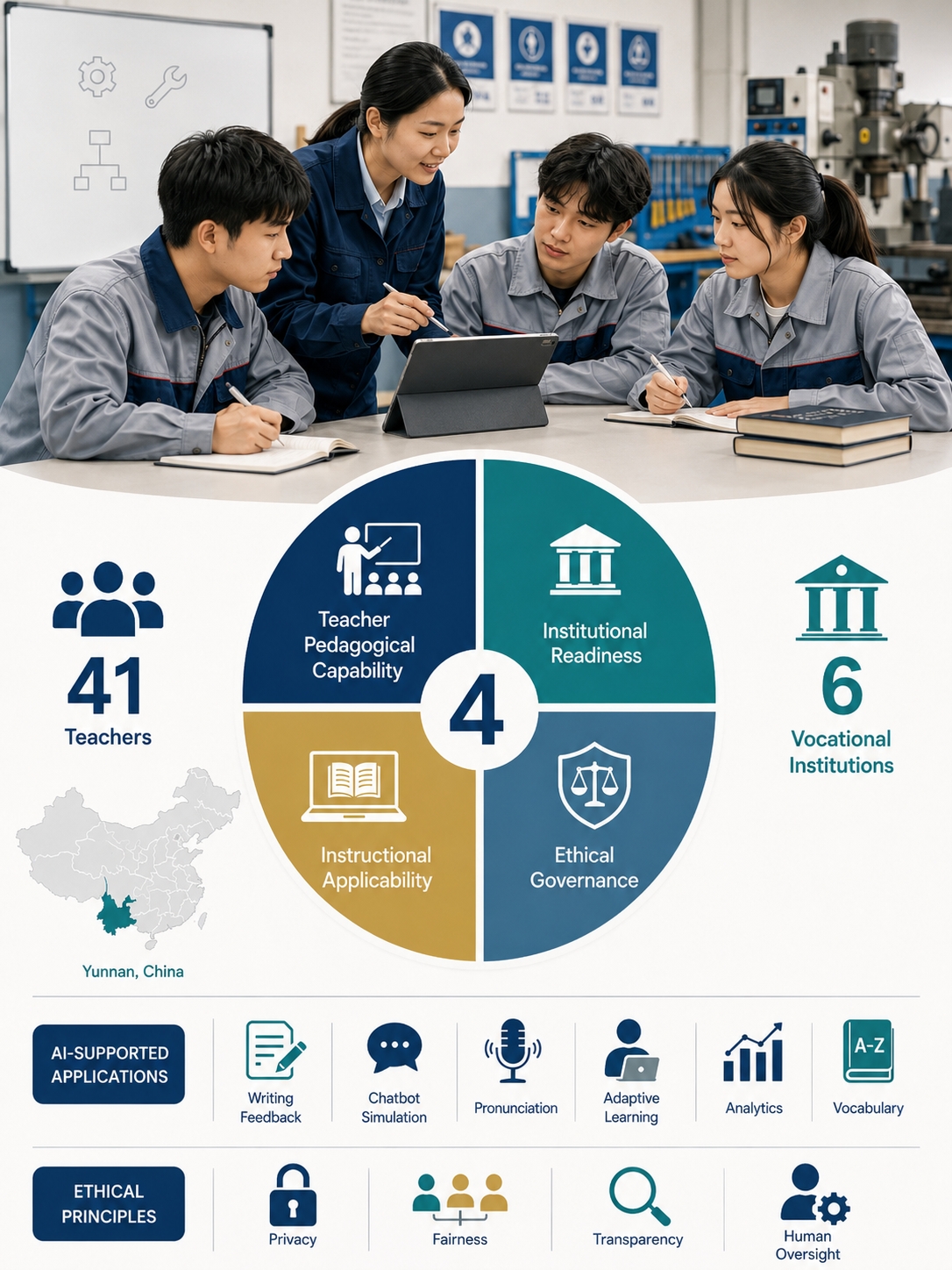
Artificial intelligence (AI) is increasingly reshaping English as a Foreign Language (EFL) instruction, yet its integration in vocational education remains insufficiently explained by adoption-oriented or tool-centered models. In vocational EFL, teachers must ensure that AI-supported learning is pedagogically meaningful, workplace-relevant, and ethically governed. This study develops an empirically informed pedagogical capability framework for integrating AI into vocational EFL teaching in China, from teachers’ perspectives. A qualitative exploratory design was employed with 41 vocational EFL teachers from six vocational and technical institutions in Yunnan Province, China. Data were collected through 18 semi-structured interviews and 23 extended open-ended survey responses. Reflexive thematic analysis was used to generate themes and synthesize framework dimensions, supported by coding summaries, source comparison, and reflexive memoing. Three themes emerged: teacher pedagogical capability and readiness, institutional and ethical barriers, and instructional applicability of AI tools. Teachers distinguished general digital competence from AI-specific pedagogical judgment, particularly in validating AI feedback, designing workplace-oriented tasks, protecting learner agency, and addressing privacy, authorship, bias, and overreliance. AI tools were perceived as useful for writing feedback, chatbot-based workplace simulation, pronunciation practice, adaptive learning, learner analytics, and occupation-specific vocabulary support, but only under teacher mediation and institutional support. Meaningful AI integration in vocational EFL depends on four interdependent dimensions: teacher pedagogical capability, institutional readiness, instructional applicability, and ethical governance. The framework extends TPACK, TAM, UTAUT, digital competence, and AI literacy by repositioning AI integration as a relational, human-centered, and context-sensitive pedagogical process.
Downloads
Article Details

This work is licensed under a Creative Commons Attribution-ShareAlike 4.0 International License.
Authors who publish with this journal agree to the following terms:
- Copyright of the published article belongs to the authors and grant the journal right of first publication with the work simultaneously licensed under a Creative Commons Attribution-ShareAlike 4.0 (CC BY SA) International License that allows others to share the work with an acknowledgment of the work's authorship and initial publication in this journal.
- Authors are able to enter into separate, additional contractual arrangements for the non-exclusive distribution of the journal's published version of the work (e.g., post it to an institutional repository or publish it in a book), with an acknowledgment of its initial publication in this journal.
- Authors are permitted and encouraged to post their work online (e.g., in institutional repositories or on their website) prior to and during the submission process, as it can lead to productive exchanges, as well as earlier and greater citation of published work (See the Effect of Open Access).
References
[1] W. Holmes, M. Bialik, and C. Fadel, Artificial intelligence in education: promises and implications for teaching and learning. Boston, Massachusetts, United State: Center for Curriculum Redesign, 2019. [Online]. Available: https://curriculumredesign.org/wp-content/uploads/AIED-Book-Excerpt-CCR.pdf
[2] O. Zawacki-Richter, V. I. Marín, M. Bond, and F. Gouverneur, “Systematic review of research on artificial intelligence applications in higher education – where are the educators?,” Int. J. Educ. Technol. High. Educ., vol. 16, no. 1, p. 39, 2019, https://doi.org/10.1186/s41239-019-0171-0
[3] F. Albedah, “Artificial Intelligence in Language Education: A Systematic Review of Multilingual Applications, Large Language Models, and Emerging Challenges,” Lang. Teach. Res. Q., vol. 49, pp. 247–268, 2025, https://doi.org/10.32038/ltrq.2025.49.13
[4] S. Zeng and C. Della, “A Systematic Review of Professional Communication Skills in English for Specific Purposes in Vocational Education within the New Media Era,” Eurasian J. Educ. Res., vol. 2024, no. 114, pp. 226–249, 2024, https://doi.org/10.14689/ejer.2024.114.013
[5] Q. U. Ain and M. K. S. Azam, “Artificial Intelligence in Language Education: A Review of Emerging Trends and Implications,” Pakistan Lang. Humanit. Rev., vol. 9, no. IV, pp. 150–166, 2025, https://doi.org/10.47205/plhr.2025(9-iv)14
[6] D. R. E. Cotton, P. A. Cotton, and J. R. Shipway, “Chatting and cheating: Ensuring academic integrity in the era of ChatGPT,” Innov. Educ. Teach. Int., vol. 61, no. 2, pp. 228–239, 2024, https://doi.org/10.1080/14703297.2023.2190148
[7] E. Kasneci et al., “ChatGPT for good? On opportunities and challenges of large language models for education,” Learn. Individ. Differ., vol. 103, p. 102274, 2023, https://doi.org/10.1016/j.lindif.2023.102274
[8] C. Wang, B. Zou, Y. Du, and Z. Wang, “The impact of different conversational generative AI chatbots on EFL learners: An analysis of willingness to communicate, foreign language speaking anxiety, and self-perceived communicative competence,” System, vol. 127, p. 103533, 2024, https://doi.org/10.1016/j.system.2024.103533
[9] M. Airaj, “Ethical artificial intelligence for teaching-learning in higher education,” Educ. Inf. Technol., vol. 29, no. 13, pp. 17145–17167, 2024, https://doi.org/10.1007/s10639-024-12545-x
[10] W. Holmes and F. Miao, Guidance for generative AI in education and research. Unesco Publishing, 2023.
[11] W. Holmes and I. Tuomi, “State of the art and practice in AI in education,” Eur. J. Educ., vol. 57, no. 4, pp. 542–570, 2022, https://doi.org/10.1111/ejed.12533
[12] R. Luckin, W. Holmes, M. Griffiths, and L. B. Forcier, Intelligence Unleashed. An argument for AI in Education. London, United Kingdom: Pearson & UCL Knowledge Lab., 2016. [Online]. Available: https://static.googleusercontent.com/media/edu.google.com/en//pdfs/Intelligence-Unleashed-Publication.pdf
[13] P. Mishra and M. J. Koehler, “Technological pedagogical content knowledge: A framework for teacher knowledge,” Teach. Coll. Rec., vol. 108, no. 6, pp. 1017–1054, 2006, https://doi.org/10.1111/j.1467-9620.2006.00684.x
[14] UNESCO, Reimagining our futures together: A new social contract for education. Paris: UNESCO, 2025. https://doi.org/10.1163/9789004738058
[15] China Daily, “More pilot cities to fall under vocational education roadmap,” State Council of the People’s Republic of China, 2023.
https://english.www.gov.cn/policies/policywatch/202306/14/content_WS64891202c6d0868f4e8dcd47.html
[16] China Daily, “Vocational education reform made major national goal,” State Council of the People’s Republic of China, 2023. https://english.www.gov.cn/policies/policywatch/202301/18/content_WS63c76385c6d0a757729e5c5a.html
[17] M. Cukurova and F. Miao, AI competency framework for teachers. UNESCO Publishing, 2024. https://doi.org/10.54675/zjte2084
[18] L. Kohnke, B. L. Moorhouse, and D. Zou, “ChatGPT for Language Teaching and Learning,” RELC J., vol. 54, no. 2, pp. 537–550, 2023, https://doi.org/10.1177/00336882231162868
[19] C. Redecker, European framework for the digital competence of educators: DigCompEdu. 2017.
[20] F. D. Davis, “Perceived usefulness, perceived ease of use, and user acceptance of information technology,” MIS Q. Manag. Inf. Syst., vol. 13, no. 3, pp. 319–339, 1989, https://doi.org/10.2307/249008
[21] V. Venkatesh, M. G. Morris, G. B. Davis, and F. D. Davis, “User acceptance of information technology: Toward a unified view,” MIS Q. Manag. Inf. Syst., vol. 27, no. 3, pp. 425–478, 2003, https://doi.org/10.2307/30036540
[22] D. T. K. Ng, J. K. L. Leung, S. K. W. Chu, and M. S. Qiao, “Conceptualizing AI literacy: An exploratory review,” Comput. Educ. Artif. Intell., vol. 2, p. 100041, 2021, https://doi.org/10.1016/j.caeai.2021.100041
[23] A. Daud, A. F. Aulia, Z. Harfal, O. Nabilla, and H. S. Ali, “Integrating artificial intelligence into English language teaching: A systematic review,” Eur. J. Educ. Res., vol. 14, no. 2, pp. 677–691, 2025, https://doi.org/10.12973/eu-jer.14.2.677
[24] Y. Li, X. Zhou, H. B. Yin, and T. K. F. Chiu, “Design language learning with artificial intelligence (AI) chatbots based on activity theory from a systematic review,” Smart Learn. Environ., vol. 12, no. 1, p. 24, 2025, https://doi.org/10.1186/s40561-025-00379-0
[25] J. Du and B. K. Daniel, “Transforming language education: A systematic review of AI-powered chatbots for English as a foreign language speaking practice,” Comput. Educ. Artif. Intell., vol. 6, p. 100230, 2024, https://doi.org/10.1016/j.caeai.2024.100230
[26] J. W. Creswell and C. N. Poth, Qualitative inquiry and research design: Choosing among five approaches, 5th ed. California: SAGE Publications, 2024.
[27] J. A. Maxwell, Qualitative research design: An interactive approach: An interactive approach. sage, 2013.
[28] E. J. Tisdell, S. B. Merriam, and H. L. Stuckey-Peyrot, Qualitative research: A guide to design and implementation. John Wiley & Sons, 2025.
[29] S. M. Ravitch and M. Riggan, Reason & rigor: How conceptual frameworks guide research. Sage publications, 2016.
[30] L. Varpio, E. Paradis, S. Uijtdehaage, and M. Young, “The Distinctions Between Theory, Theoretical Framework, and Conceptual Framework,” Acad. Med., vol. 95, no. 7, pp. 989–994, 2020, https://doi.org/10.1097/ACM.0000000000003075
[31] V. Braun and V. Clarke, “Thematic analysis: A practical guide,” 2022.
[32] L. S. Nowell, J. M. Norris, D. E. White, and N. J. Moules, “Thematic Analysis: Striving to Meet the Trustworthiness Criteria,” Int. J. Qual. Methods, vol. 16, no. 1, pp. 1–13, 2017, https://doi.org/10.1177/1609406917733847
[33] J. A. Maxwell, “Using numbers in qualitative research,” Qual. Inq., vol. 16, no. 6, pp. 475–482, 2010.
[34] M. Sandelowski, “Real qualitative researchers do not count: The use of numbers in qualitative research,” Res. Nurs. Health, vol. 24, no. 3, pp. 230–240, 2001. https://doi.org/10.1002/nur.1025
[35] B. C. O’Brien, I. B. Harris, T. J. Beckman, D. A. Reed, and D. A. Cook, “Standards for reporting qualitative research: A synthesis of recommendations,” Acad. Med., vol. 89, no. 9, pp. 1245–1251, 2014, https://doi.org/10.1097/ACM.0000000000000388
[36] A. Tong, P. Sainsbury, and J. Craig, “Consolidated criteria for reporting qualitative research (COREQ): A 32-item checklist for interviews and focus groups,” Int. J. Qual. Heal. Care, vol. 19, no. 6, pp. 349–357, 2007, https://doi.org/10.1093/intqhc/mzm042
[37] M. Q. Patton, Qualitative research & evaluation methods: Integrating theory and practice, 4th ed. Thousand Oaks, CA, 2015.
[38] L. A. Palinkas, S. M. Horwitz, C. A. Green, J. P. Wisdom, N. Duan, and K. Hoagwood, “Purposeful Sampling for Qualitative Data Collection and Analysis in Mixed Method Implementation Research,” Adm. Policy Ment. Heal. Ment. Heal. Serv. Res., vol. 42, no. 5, pp. 533–544, 2015, https://doi.org/10.1007/s10488-013-0528-y
[39] K. Malterud, V. D. Siersma, and A. D. Guassora, “Sample Size in Qualitative Interview Studies: Guided by Information Power,” Qual. Health Res., vol. 26, no. 13, pp. 1753–1760, 2016, https://doi.org/10.1177/1049732315617444
[40] V. Braun, V. Clarke, E. Boulton, L. Davey, and C. McEvoy, “The online survey as a qualitative research tool,” Int. J. Soc. Res. Methodol., vol. 24, no. 6, pp. 641–654, 2021, https://doi.org/10.1080/13645579.2020.1805550
[41] V. Braun and V. Clarke, “Reflecting on reflexive thematic analysis,” Qual. Res. Sport. Exerc. Heal., vol. 11, no. 4, pp. 589–597, 2019, https://doi.org/10.1080/2159676X.2019.1628806
[42] R. A. Croker, “An introduction to qualitative research,” Qual. Res. Appl. Linguist. A Pract. Introd., pp. 3–24, 2009, https://doi.org/10.1057/9780230239517
[43] S. Kvale and S. Brinkmann, Interviews: Learning the craft of qualitative research interviewing. sage, 2009.
[44] S. Brinkmann, “Unstructured and Semi-Structured Interviewing,” Oxford Handb. Qual. Res., vol. 277, pp. 276–299, 2014, https://doi.org/10.1093/oxfordhb/9780199811755.013.030
[45] Y. S. Lincoln and E. G. Guba, Naturalistic inquiry. sage, 1985.
[46] V. Braun and V. Clarke, “Using thematic analysis in psychology,” Qual. Res. Psychol., vol. 3, no. 2, pp. 77–101, 2006, https://doi.org/10.1191/1478088706qp063oa
[47] L. Finlay, “Negotiating the swamp: The opportunity and challenge of reflexivity in research practice,” Qual. Res., vol. 2, no. 2, pp. 209–230, 2002, https://doi.org/10.1177/146879410200200205
[48] R. Berger, “Now I see it, now I don’t: researcher’s position and reflexivity in qualitative research,” Qual. Res., vol. 15, no. 2, pp. 219–234, 2015, https://doi.org/10.1177/1468794112468475
[49] S. J. Tracy, “Qualitative quality: Eight a"big-tent" criteria for excellent qualitative research,” Qual. Inq., vol. 16, no. 10, pp. 837–851, 2010, https://doi.org/10.1177/1077800410383121
[50] M. Ramazanoglu and T. Akın, “AI readiness scale for teachers: Development and validation,” Educ. Inf. Technol., vol. 30, no. 6, pp. 6869–6897, 2025, https://doi.org/10.1007/s10639-024-13087-y
[51] A. R. Rahimi and A. Sevilla-Pavón, “The role of ChatGPT readiness in shaping language teachers’ language teaching innovation and meeting accountability: A bisymmetric approach,” Comput. Educ. Artif. Intell., vol. 7, p. 100258, 2024, https://doi.org/10.1016/j.caeai.2024.100258
[52] M. Zhu and C. Wang, “A systematic review of research on AI in language education: Current status and future implications,” Lang. Learn. Technol., vol. 29, no. 1, pp. 1–29, 2025, https://doi.org/10.64152/10125/73606
[53] L. Zheng and Y. Yang, “Research perspectives and trends in Artificial Intelligence-enhanced language education: A review,” Heliyon, vol. 10, no. 19, 2024, https://doi.org/10.1016/j.heliyon.2024.e38617
[54] S. Lee, H. Choe, D. Zou, and J. Jeon, “Generative AI (GenAI) in the language classroom: A systematic review,” Interact. Learn. Environ., vol. 34, no. 1, pp. 335–359, 2025, https://doi.org/10.1080/10494820.2025.2498537
[55] B. Li, Y. L. Tan, C. Wang, and V. Lowell, “Two years of innovation: A systematic review of empirical generative AI research in language learning and teaching,” Comput. Educ. Artif. Intell., vol. 9, p. 100445, 2025, https://doi.org/10.1016/j.caeai.2025.100445
[56] W. Liu, “Language teacher AI literacy: insights from collaborations with ChatGPT,” J. China Comput. Lang. Learn., vol. 5, no. 2, pp. 287–316, 2025, https://doi.org/10.1515/jccall-2024-0030
[57] A. Yusuf, N. Pervin, and M. Román-González, “Generative AI and the future of higher education: a threat to academic integrity or reformation? Evidence from multicultural perspectives,” Int. J. Educ. Technol. High. Educ., vol. 21, no. 1, p. 21, 2024, https://doi.org/10.1186/s41239-024-00453-6
[58] C. K. Y. Chan, “A comprehensive AI policy education framework for university teaching and learning,” Int. J. Educ. Technol. High. Educ., vol. 20, no. 1, p. 38, 2023, https://doi.org/10.1186/s41239-023-00408-3
[59] I. M. García-López and L. Trujillo-Liñán, “Correction: Ethical and regulatory challenges of Generative AI in education: a systematic review,” in Frontiers in Education, 2025, vol. 10, p. 1565938. https://doi.org/10.3389/feduc.2025.1681252
[60] K. Bittle and O. El-Gayar, “Generative AI and Academic Integrity in Higher Education: A Systematic Review and Research Agenda,” Inf., vol. 16, no. 4, p. 296, 2025, https://doi.org/10.3390/info16040296
[61] S. R. Hill and A. Tombs, “The effect of accent of service employee on customer service evaluation,” Manag. Serv. Qual., vol. 21, no. 6, pp. 649–666, 2011, https://doi.org/10.1108/09604521111185637
[62] W. Huang, K. F. Hew, and L. K. Fryer, “Chatbots for language learning—Are they really useful? A systematic review of chatbot-supported language learning,” J. Comput. Assist. Learn., vol. 38, no. 1, pp. 237–257, 2022, https://doi.org/10.1111/jcal.12610
[63] A. Şahin Kızıl, B. Klimova, M. Pikhart, and A. Parmaxi, “A Systematic Review of the Recent Research on the Usefulness of Chatbots for Language Education,” J. Comput. Assist. Learn., vol. 41, no. 2, p. e70001, 2025, https://doi.org/10.1111/jcal.70001
[64] R. Godwin-Jones, “Distributed agency in second language learning and teaching through generative AI,” Lang. Learn. Technol., vol. 28, no. 2, pp. 5–31, 2024, https://doi.org/10.64152/10125/73570